

Radio-Frequency Identification (RFID) provides a foundational wireless technology that uses electromagnetic fields to identify and track tagged objects automatically. Within the Internet of Things (IoT) ecosystem, RFID serves as an essential data-collection layer, seamlessly bridging physical items with digital enterprise networks.
Unlike traditional optical barcodes, RFID scans tags without requiring a direct line of sight. Consequently, RFID dramatically speeds up automation, asset tracking, and supply chain logistics.
How an RFID System Works
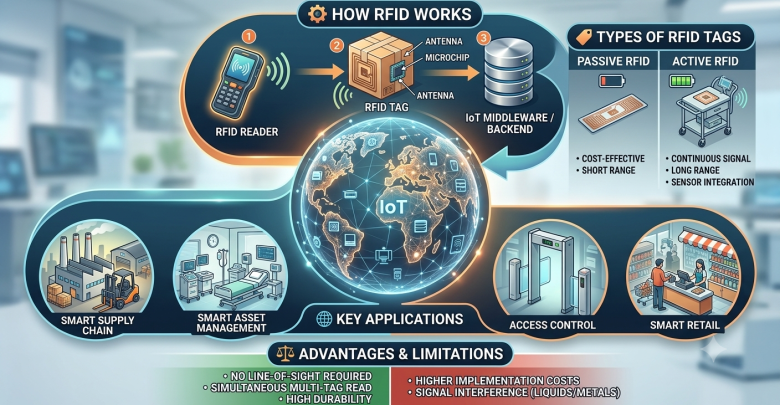
A standard RFID infrastructure relies on three interconnected core components:
- RFID Tag (Transponder): Attached directly to objects, each tag contains a microchip for storing data and an antenna for transmitting radio signals.
- RFID Reader (Interrogator): A network-connected device equipped with an antenna that emits radio waves and receives return signals from nearby tags.
- Backend Middleware: Dedicated software that processes raw tag data and routes it directly into IoT platforms, inventory databases, or ERP systems.
Comparison of RFID Tag Types
RFID tags fall into three primary categories based on their internal power source:
- Passive RFID Tags: Passive tags contain no internal battery. Instead, they draw operational power directly from the electromagnetic energy transmitted by the RFID reader. While offering a shorter read range (up to a few meters), passive tags deliver an virtually unlimited operational lifespan at a low cost.
- Active RFID Tags: Equipped with an internal battery, active tags continuously broadcast their own radio signals over long distances (up to 100 meters or more). They frequently include environmental sensors for monitoring temperature or humidity across high-value asset deployments.
- Semi-Passive Tags (Battery-Assisted Passive): These tags utilize a small internal battery to power the internal microchip circuitry while relying on reader energy to transmit the radio response back.
Passive vs. Active RFID Systems
The following table summarizes the primary differences between Passive and Active RFID deployments:
| Feature | Passive RFID | Active RFID |
|---|---|---|
| Internal Power Source | None (Powered by Reader Signal) | Built-in Internal Battery |
| Read Range | Short (Up to 10 meters) | Long (Up to 100+ meters) |
| Operational Lifespan | Almost Unlimited | 3 to 5 Years (Battery Dependent) |
| Sensor Integration | Basic Data Only | Advanced (Temperature, Humidity, Motion) |
| Relative Cost | Ultra-Low Cost | Higher Investment |
Key Applications of RFID in IoT
RFID technology transforms diverse industrial and enterprise sectors through real-time tracking:
- Supply Chain & Smart Logistics: Delivers real-time tracking of goods from manufacturing plants to retail shelves, eliminating inventory discrepancies.
- Smart Asset Management: Tracks critical hospital equipment, industrial tools, and heavy machinery automatically across large facilities.
- Access Control & Security: Powers secure ID badges, contactless key fobs, and automated electronic toll collection systems.
- Smart Retail Environments: Enables instant multi-item checkout stations, smart fitting rooms, and real-time stock notifications.
Advantages and System Limitations
Key Advantages
- Scans tags instantly through plastic, cardboard, and wooden enclosures without direct line-of-sight positioning.
- Reads hundreds of RFID tags simultaneously within seconds.
- Protects internal data in harsh industrial environments containing dust, extreme heat, or moisture.
System Limitations
- Requires a higher initial hardware investment compared to printed paper barcodes.
- Encounters signal reflection or attenuation when operating near dense metals or liquids.
Conclusion
RFID technology continues to serve as an indispensable bridge connecting physical assets to digital IoT cloud platforms. By choosing between passive, active, or semi-passive tag architectures, enterprise organizations build scalable, highly efficient automated tracking systems worldwide.