
Send every sensor reading from a factory floor straight to the cloud, and you’ll quickly run into three problems at once. Network bandwidth costs climb. Latency creeps in right when a split-second decision matters most. And a lost internet connection can mean a blind production line. Edge computing solves this by moving processing power closer to where the data actually gets generated — right at the “edge” of the network, not in a distant data center.
This guide covers what edge computing actually means in an industrial IoT context. We’ll also look at how it fits alongside the PLC and SCADA systems already running the factory floor, and when it makes sense over a pure cloud approach.
What Is Edge Computing?
Edge computing means processing data physically close to where it’s generated, rather than sending everything to a centralized cloud or data center first. In an industrial IoT context, this typically means a local computing device. It might sit on the factory floor, in a control cabinet, or built directly into a piece of equipment. This device analyzes sensor data in real time, right where the action happens.
The term “edge” refers to the network edge — the boundary between the local industrial environment and the broader internet. Data processed at the edge doesn’t need to travel across that boundary before a decision gets made.
Why Industrial IoT Needs Edge Computing
Latency-Sensitive Decisions
Some industrial processes need decisions in milliseconds. Think of a safety shutdown, a quality control rejection on a fast-moving production line, or a robotic arm adjustment. Round-tripping that data to a cloud server and back introduces delay. Many time-critical applications simply can’t tolerate that delay. Processing locally, at the edge, keeps the decision loop fast enough to matter.
Bandwidth and Cost Constraints
A single industrial facility can generate an enormous volume of sensor data — vibration readings, temperature logs, video feeds from quality inspection cameras. Sending all of this raw data to the cloud continuously can be expensive and often unnecessary. Instead, edge computing can filter, aggregate, or analyze data locally. As a result, only meaningful summaries or exceptions need to reach the cloud, not a continuous raw stream.
Reliability During Connectivity Loss
Factories don’t always have rock-solid internet connectivity. Even when they do, outages happen. If a process depends entirely on cloud connectivity to function, a connectivity loss can halt operations. Worse, it can leave safety-critical systems without the data they need. Edge computing keeps critical processing running locally, independent of whether the connection to the cloud is currently available.
Data Privacy and Security Considerations
Some organizations prefer to keep sensitive operational data within their own facility. They may avoid transmitting it to third-party cloud infrastructure for competitive, regulatory, or security reasons. Edge computing allows meaningful analysis to happen without that data ever needing to leave the local network in raw form.
How Edge Computing Fits with Existing Industrial Systems
Edge computing doesn’t replace the PLCs, SCADA, and other systems covered in our industrial automation guide. Instead, it works alongside them, typically sitting at a layer between the real-time control systems and the cloud.
Edge Gateways
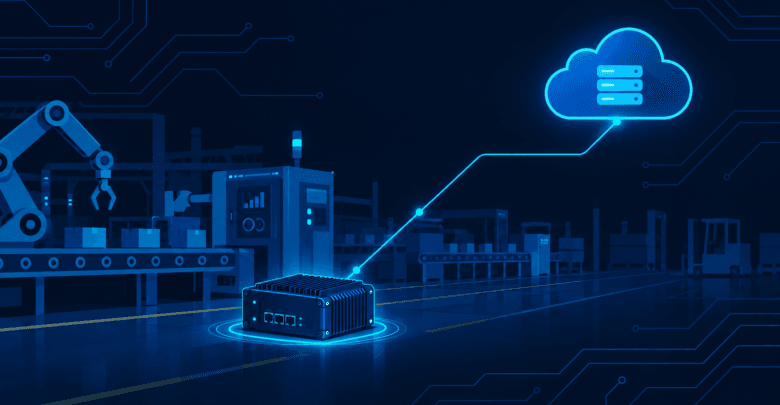
An edge gateway is a common entry point. It’s a ruggedized industrial computer that collects data from PLCs and sensors, applies local processing or analytics, and manages what gets sent onward to the cloud. This device often speaks industrial protocols like Modbus or OPC UA on one side, and standard internet protocols on the other.
Edge Analytics and Machine Learning
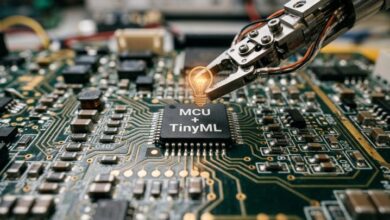
More sophisticated edge deployments run analytics or even machine learning models directly on local hardware. This enables real-time anomaly detection or predictive maintenance calculations without needing a round trip to the cloud for every inference.
Edge-to-Cloud Data Flow
In a well-designed system, the edge layer handles time-sensitive, high-volume processing locally. Then, it sends summarized, filtered, or exception-based data up to the cloud for longer-term storage, cross-site analytics, and integration with enterprise systems.
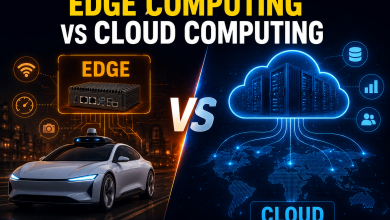
Edge Computing vs Cloud Computing: Where Each Fits
Choose Edge Processing When:
- Decisions need to happen in milliseconds, not seconds.
- Network connectivity is unreliable or expensive.
- Raw data volume is too large to justify continuous cloud transmission.
- Data sensitivity requires keeping information within the local facility.
Choose Cloud Processing When:
- Analysis requires aggregating data across multiple sites or a long historical window.
- Computational demands exceed what local edge hardware can reasonably handle.
- The application benefits from centralized management, updates, or cross-facility comparison.
- Real-time response isn’t critical to the specific use case.
Most mature industrial IoT deployments use both. They split workloads based on which characteristics matter most for each specific task, rather than committing entirely to one approach.
Practical Applications of Edge Computing in Industry
Predictive Maintenance
Vibration and acoustic sensors on rotating equipment can generate enormous data volumes. Edge processing analyzes this data locally, flagging anomalies in real time. Only relevant alerts and summarized trends get sent to the cloud — similar in principle to the predictive maintenance approaches covered in our IoT aircraft maintenance guide.
Quality Control and Machine Vision
Camera-based quality inspection systems on fast-moving production lines need to make pass/fail decisions in real time. Edge computing processes the image analysis locally. This way, it keeps pace with production speed without waiting on cloud round-trips.
Energy Management
Edge devices can monitor and control energy usage across industrial equipment in real time. They optimize consumption locally based on current conditions, while still reporting aggregated data to cloud-based systems for facility-wide reporting.
Digital Twin Data Feeds
Edge processing can pre-process and filter sensor data before it feeds into digital twin platforms. As a result, the digital twin receives clean, relevant data without overwhelming cloud infrastructure with every raw sensor reading.
Challenges of Deploying Edge Computing
Hardware Deployment and Maintenance
Unlike cloud infrastructure managed centrally by a provider, edge hardware lives physically distributed across a facility. This requires on-site deployment, maintenance, and eventual hardware refresh cycles managed by the organization itself.
Software Updates at Scale
Keeping software and security patches current across potentially hundreds of distributed edge devices is operationally complex. It requires far more robust remote management than updating a centralized cloud service.
Balancing Edge and Cloud Workloads
Deciding what to process at the edge versus what to send to the cloud isn’t always obvious. Getting this balance wrong can mean either underutilizing edge hardware or creating unnecessary cloud costs and latency. Consequently, this architectural decision typically requires ongoing tuning as an organization’s needs evolve.
Security of Distributed Devices
Every edge device represents a potential entry point for security threats. Securing a large number of physically distributed devices — some potentially in less controlled environments than a locked data center — requires deliberate security architecture. This echoes the broader OT vs IT security challenges common across industrial IoT.
Conclusion
Edge computing has become a foundational piece of practical industrial IoT architecture. It hasn’t replaced cloud computing — instead, it solves specific problems that pure cloud approaches handle poorly in industrial settings, including latency, bandwidth, reliability, and data sensitivity. Understanding when to process data locally versus in the cloud matters. So does designing systems that use both deliberately, rather than defaulting entirely to one. This is core to building industrial IoT systems that actually perform well in real-world factory conditions.
For more on how this fits into the broader industrial automation picture, our guides on Industrial Automation and PLC and OT vs IT cover the systems and organizational dynamics edge computing needs to work alongside.