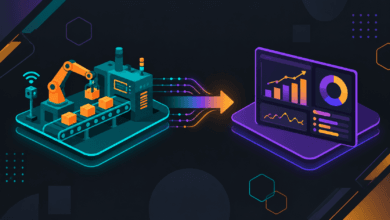

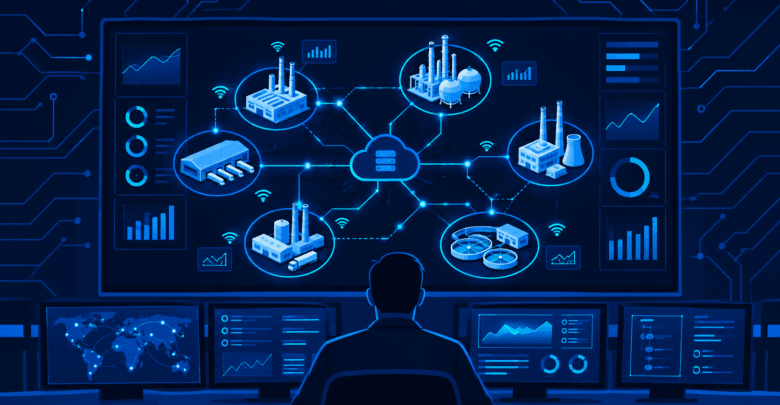
A single PLC can control a machine. But what happens when an operation spans hundreds of machines across a sprawling facility, or a pipeline network stretching across an entire region? That’s where SCADA comes in — the layer of industrial automation responsible for watching over, coordinating, and making sense of everything happening across a large, distributed operation.
This guide covers what SCADA systems actually do, how they’re structured, and where they fit alongside the PLCs and other control systems already running on the factory floor.
What Is SCADA?
SCADA stands for Supervisory Control and Data Acquisition. It’s a category of software and hardware systems that monitor and control industrial processes at a supervisory level. These systems sit above individual PLCs and field devices, aggregating their data and providing centralized visibility and control across an entire operation.
A PLC directly executes real-time control logic on a specific machine or process. SCADA, by contrast, operates one level up. It watches, coordinates, and lets human operators intervene when needed, but it typically doesn’t handle the millisecond-level control decisions that PLCs are built for.
The Core Components of a SCADA System
Remote Terminal Units (RTUs) and PLCs
SCADA gathers data from field-level devices — often PLCs, but sometimes dedicated Remote Terminal Units (RTUs). These serve a similar role but appear frequently in geographically distributed applications like pipelines or utility networks. Engineers design them for lower power consumption and remote communication over longer distances.
Communication Infrastructure
Moving data from potentially distant field devices back to a central monitoring location requires reliable communication infrastructure. This can involve wired networks within a single facility. Alternatively, it can involve longer-range communication methods — radio, cellular, satellite, or leased telecom lines — for widely distributed operations.
The SCADA Master (Central Server)
The central SCADA server aggregates incoming data from all connected field devices. It processes and stores that data, triggers alarms based on configured conditions, and serves data to operator interfaces. In effect, this is the system’s “brain.”
Human-Machine Interface (HMI)
Operators interact with the SCADA system through an HMI. These screens display real-time process data, often through graphical representations of the physical system. This visual approach makes it intuitive to understand current conditions and spot problems quickly.
Historian Database
Most SCADA systems include a historian, a specialized database that logs process data over time. In turn, this historian enables trend analysis, reporting, and troubleshooting based on historical patterns.
How SCADA Systems Actually Work
Data Acquisition
First, field devices continuously measure conditions — pressure, flow, temperature, valve positions, equipment status. From there, RTUs or PLCs collect this data and transmit it to the central SCADA system on a regular polling cycle or as events occur.
Data Processing and Visualization
The SCADA master processes incoming data. As a result, it updates the HMI in near real-time, so operators see current conditions across the entire operation from a single interface.
Alarming
SCADA systems continuously check incoming data against configured thresholds. Accordingly, they trigger alarms when values fall outside expected ranges, alerting operators to conditions that need attention before they escalate.
Supervisory Control
Beyond monitoring, many SCADA systems let operators send control commands back down to field devices. For instance, they can open a valve remotely, adjust a setpoint, or start and stop equipment — all from the centralized interface.
Common SCADA Applications
Water and Wastewater Treatment
Municipal utilities rely on SCADA to monitor and control treatment processes, pump stations, and distribution networks across often widely dispersed infrastructure.
Oil and Gas
Similarly, pipeline monitoring, well site automation, and refinery process control all rely heavily on SCADA, often across extremely large geographic areas.
Electric Power Utilities
Power companies use SCADA to monitor and control generation, transmission, and distribution networks. In this role, the system plays a critical part in grid stability and rapid response to outages.
Manufacturing
Within a single facility, meanwhile, SCADA provides plant-wide visibility across multiple production lines. In addition, it complements the more granular control that individual PLCs handle.
Building and Facility Management
Larger facilities sometimes use SCADA-like systems to monitor and control HVAC, power, and other building systems across a campus, echoing some of the smart terminal concepts covered in our airport operations guide.
SCADA vs DCS: What’s the Difference?
SCADA and DCS (Distributed Control System) solve related problems but historically emerged from different needs. SCADA traditionally excels at supervisory monitoring and control across geographically distributed assets, where the control logic itself often lives in individually programmed PLCs or RTUs at each site. DCS, on the other hand, typically serves continuous process industries concentrated in a single facility, where control logic gets tightly integrated and distributed across many controllers.
Over time, the distinction has blurred considerably, as both categories have absorbed features from each other.
SCADA Security Considerations
Engineers historically designed SCADA systems assuming isolated, trusted networks. However, this assumption has become increasingly risky as more SCADA systems connect to broader IT networks and the cloud. In turn, this connects directly to the broader OT vs IT security challenges facing industrial environments generally: SCADA systems often control genuinely critical infrastructure, making their security a matter of significant public interest.
Consequently, modern SCADA security practices typically include network segmentation separating SCADA networks from general IT infrastructure, strict access controls, and purpose-built industrial cybersecurity monitoring tools.
Modern SCADA and IIoT Integration
Traditional SCADA excels at real-time monitoring and control. However, engineers didn’t originally design it for the kind of historical trend analysis and machine learning-driven insights that modern IIoT platforms provide. As a result, organizations increasingly layer IIoT capabilities on top of existing SCADA infrastructure. For example, they pull data from SCADA historians into cloud analytics platforms, feed SCADA data into digital twin models, or apply edge computing to pre-process data before it reaches the SCADA system itself.
Conclusion
SCADA systems provide the supervisory layer that makes it possible to monitor and coordinate industrial operations too large or too distributed for any single operator to oversee directly. From municipal water systems to continent-spanning pipelines, SCADA’s core job remains essential even as the technology around it evolves. Ultimately, it keeps incorporating cloud connectivity, advanced analytics, and tighter integration with modern IIoT platforms.
For a closer look at the field-level systems SCADA typically connects to, our guide on Industrial Automation and PLC covers the broader automation ecosystem SCADA sits within.