



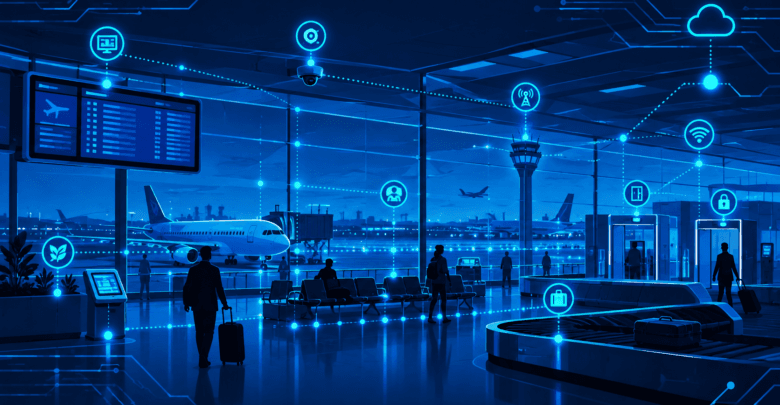
Airports rank among the most complex operational environments in the world. Every day, thousands of passengers move through security, gates, and retail spaces while aircraft, baggage, ground crews, and countless systems all need to coordinate on a tight schedule. A single delay can ripple through the entire day’s operations. IoT sensors and connected systems are increasingly the backbone that keeps this complexity manageable, turning airports into “smart terminals” that sense, predict, and respond to conditions in real time.
This guide covers the main ways airports use IoT to run smarter, more efficient terminals — and the operational challenges that come with it.
Why Airports Are Investing in IoT
Airport operations face a unique combination of pressures: high passenger volumes, tight aircraft turnaround windows, strict security requirements, and enormous facilities that are expensive to staff and maintain. Traditional airport management relied heavily on manual monitoring and reactive responses. IoT sensors change this by providing continuous, real-time data across the entire terminal, enabling airports to detect and respond to issues as they emerge rather than after they’ve already affected passengers.
Key Applications of IoT in Smart Terminals
Passenger Flow Monitoring
Sensors and computer vision systems installed throughout terminals track passenger density and movement patterns in real time — at security checkpoints, gate areas, retail zones, and hallways. This data helps airport operators identify bottlenecks as they form, dynamically open additional security lanes or check-in counters, and provide passengers with live wait-time estimates through airport apps or digital signage.
Smart HVAC and Energy Management
Airport terminals are massive, energy-intensive buildings. IoT sensors monitoring occupancy, temperature, and air quality throughout different zones let building management systems adjust heating, cooling, and ventilation dynamically — rather than running at a fixed schedule regardless of how many people are actually in a given area. This reduces energy costs significantly across a facility that operates nearly around the clock.
Baggage and Cargo Handling Automation
Beyond the RFID-based tracking covered in our airline baggage tracking guide, airports themselves deploy IoT-connected sorting systems, automated guided vehicles, and sensor-monitored conveyor networks to keep bags moving efficiently through the terminal’s internal logistics, flagging jams or slowdowns before they cascade into missed connections.
Smart Parking and Ground Transportation
IoT sensors embedded in parking structures detect open spaces in real time, guiding drivers directly to available spots through app-based navigation rather than circling floor after floor. Similarly, sensor data on curbside congestion helps airports manage rideshare and taxi queuing more effectively during peak periods.
Predictive Facility Maintenance
Just as airlines use IoT for predictive maintenance on aircraft, airports apply the same principle to escalators, moving walkways, elevators, jet bridges, and baggage handling equipment. Sensors monitoring vibration, temperature, and usage patterns can flag a failing escalator motor before it breaks down mid-shift.
Environmental and Air Quality Monitoring
Airports increasingly deploy sensors that monitor air quality both inside terminals and around the airfield, tracking pollutants from aircraft and ground vehicle emissions. This data supports both passenger health considerations and regulatory compliance and sustainability reporting requirements.
Connected Digital Signage and Wayfinding
IoT-connected digital displays throughout the terminal can update dynamically based on real-time flight data, security wait times, and even localized information, replacing static signage with a system that responds to changing conditions throughout the day.
Case in Point: Integrated Airport Operations Centers
Many major airports now operate centralized “Airport Operations Centers” (AOCs) that aggregate IoT sensor data from across the entire facility — passenger flow, baggage systems, weather conditions, aircraft positioning, and more — into a single operational dashboard. This gives airport management a real-time, holistic view of the entire operation, enabling faster coordinated responses when something goes wrong, rather than each department working from separate, siloed information.
Benefits of Smart Terminal IoT
The efficiency gains compound across the whole passenger experience: shorter security wait times through dynamic lane management, reduced energy costs through responsive building systems, fewer equipment failures through predictive maintenance, and less passenger frustration through better real-time information. For airports, which often operate on thin margins relative to their enormous infrastructure costs, even modest efficiency improvements across thousands of daily operations add up to meaningful savings.
Challenges in Smart Terminal Implementation
Legacy Infrastructure
Many major airports were built decades ago, long before IoT technology existed. Retrofitting sensor networks, connectivity infrastructure, and data systems into aging buildings — often while keeping the airport fully operational during construction — is a significant and expensive undertaking.
Data Privacy Concerns
Passenger flow monitoring, especially systems using computer vision or Bluetooth/Wi-Fi signal tracking, raises legitimate privacy questions. Airports need to balance operational benefits against passenger privacy expectations and regulatory requirements like GDPR where it applies.
System Integration Complexity
A modern airport involves dozens of different vendors, systems, and stakeholders — airlines, ground handlers, security agencies, retail tenants, and the airport authority itself. Getting IoT systems from all these different parties to share data effectively remains one of the biggest practical obstacles to fully realizing the “smart terminal” vision.
Cybersecurity at Scale
An airport with thousands of connected sensors and systems presents a substantially larger attack surface than a traditional facility. Securing this many endpoints requires a level of cybersecurity coordination that not every airport authority has fully built out yet.
Conclusion
Smart terminal technology is transforming airports from static facilities into responsive systems that sense and adapt to real conditions throughout the day. From passenger flow monitoring to predictive maintenance to integrated operations centers, IoT is steadily reducing the friction points that have long defined the air travel experience. The technical challenges — legacy infrastructure, data privacy, system integration — are real, but the direction of travel is clear: airports that invest in these systems are building meaningfully more efficient and resilient operations than those still running on manual processes and siloed data.
If you’re curious how these same sensor-driven principles apply to the aircraft themselves rather than the terminal, our guide on IoT in Aircraft Maintenance covers the predictive analytics side of the aviation IoT picture.





One Comment