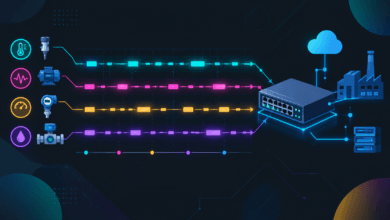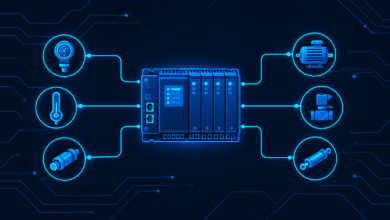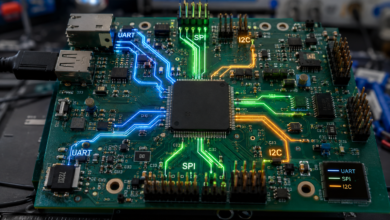


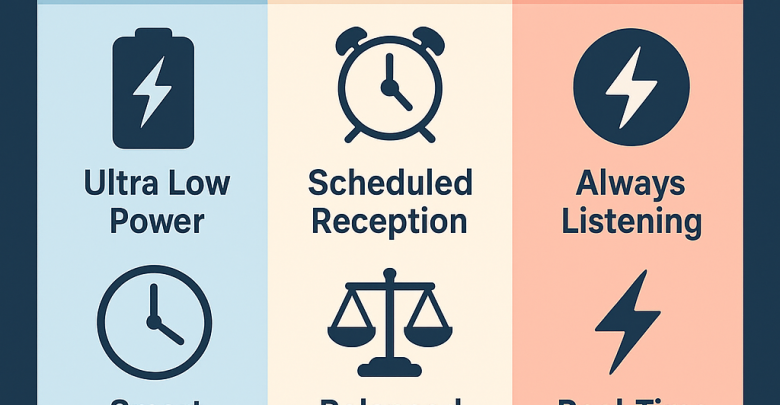
Low-Power Wide-Area Networks (LPWAN) connect battery-powered devices wirelessly across regional and national networks. Specifically, a core strength of the LoRaWAN specification lies in its structural flexibility. The standard segregates end-devices into three distinct operational profiles: Class A, Class B, and Class C.
Consequently, network architects must carefully balance power consumption constraints against downlink latency requirements when selecting a device class.
1. Class A: Maximum Energy Efficiency
Class A is the baseline framework of the LoRaWAN standard. Consequently, every certified LoRaWAN device must support Class A functionality by default.
Communication Mechanism
Class A communication is strictly bi-directional, asynchronous, and device-initiated. The end-device spends most of its lifecycle in an ultra-low-power sleep state. When an event triggers an update, the device transmits an uplink message. Immediately after this transmission, the device opens two sequential downlink reception windows.
- Downlink Latency: High and variable. The network server cannot initiate communication at will. Instead, downlinks wait in a queue until the next scheduled uplink opens the reception windows.
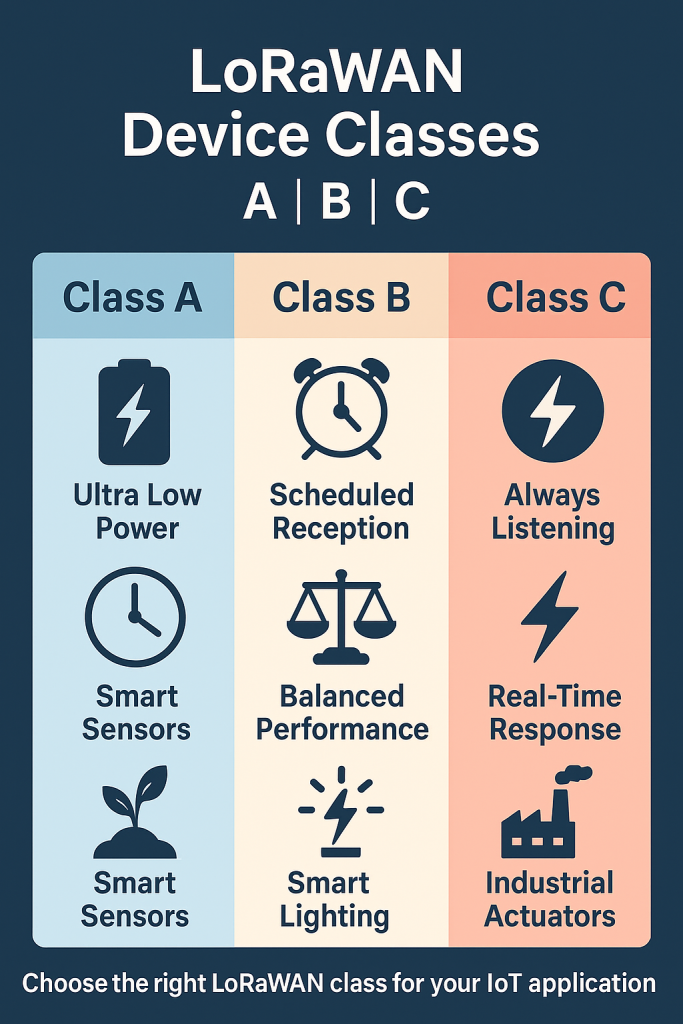
- Ideal Deployments: Perfect for “deploy-and-forget” battery applications, such as agricultural soil sensors, leak detectors, and smart utility meters.
2. Class B: Scheduled Downlink Slots
Class B builds directly upon Class A architecture. It introduces predictable, network-initiated communication without requiring continuous power.
Communication Mechanism
In addition to opening reception windows after uplinks, Class B devices open extra periodic downlink windows called “ping slots.” To achieve this, local gateways transmit time-synchronized beacons across the network. The end-device uses these beacons to align its internal clock with the network.
- Downlink Latency: Moderate and predictable. By establishing periodic listening intervals, Class B substantially reduces downlink response times compared to Class A.
- Ideal Deployments: Optimal for infrastructure requiring periodic remote control overrides, such as smart street lighting arrays, regional utility switchgear, and asset trackers.
Watch the Full Video Analysis
Explore how LoRaWAN device classes manage reception windows, beacon timing, and energy optimization in our detailed video breakdown:
📺 Watch here: LoRaWAN Device Classes Comparison on YouTube
3. Class C: Near Real-Time Responsiveness
Class C shifts the engineering priority away from power preservation to achieve minimal communication latency.
Communication Mechanism
Class C end-devices maintain their receiver circuitry in a continuous listening state. The reception window remains open indefinitely, closing only when the device actively transmits uplink data.
- Downlink Latency: Minimal and near real-time. Because the device perpetually listens to the spectrum, the network server pushes critical commands or firmware updates instantaneously.
- Ideal Deployments: Restricted to devices with continuous main power access or large solar arrays, such as industrial valve actuators, building gateways, and emergency shutoff systems.
Comprehensive Class Comparison
The following table summarizes the key operational differences between the three LoRaWAN device classes:
| Feature | Class A | Class B | Class C |
|---|---|---|---|
| Downlink Latency | High (Variable) | Medium (Scheduled) | Minimal (Real-time) |
| Energy Efficiency | Extremely High | Balanced / Moderate | Low |
| Rx Window Behavior | Opens briefly after uplink | Opens after uplink + scheduled slots | Continuous listening window |
| Power Requirement | Small battery cells | Dedicated battery packs | Mains power supply |
Technical Selection Framework
Selecting the optimal LoRaWAN class dictates both hardware design and operational lifespan. Therefore, engineers should follow these simple selection rules:
- Prioritize Class A: Choose Class A if your primary objective is a decade-long lifespan on standard battery cells without immediate remote actuation needs.
- Deploy Class B: Select Class B if your system demands predictable downlink reachability while remaining tethered to a battery power supply.
- Mandate Class C: Mandate Class C if your application demands immediate, low-latency command execution and continuous mains power is available.
Conclusion
Understanding LoRaWAN device classes ensures optimal network scalability and battery performance. By aligning application latency requirements with the appropriate operational class, developers build resilient, high-performance IoT ecosystems.
Tags:
LoRaWAN Classes | LPWAN Architecture | Class A LoRaWAN | Class B LoRaWAN | Class C LoRaWAN | Downlink Latency | Power Optimization | Network Beacons | Actuator Control | Smart Infrastructure