
What is an eSIM and How Does it Drive IoT Growth?
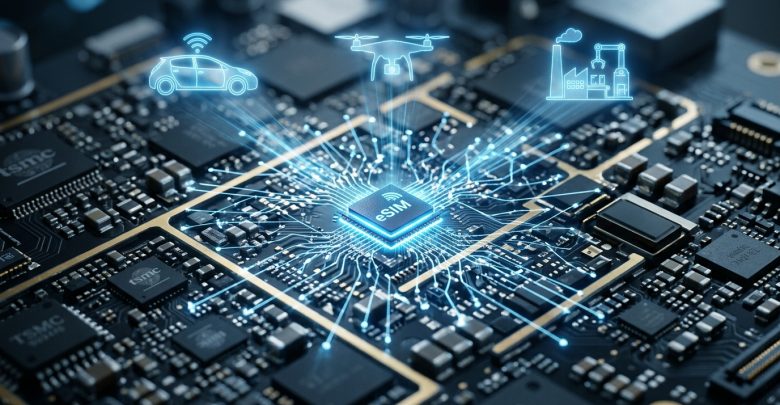
Unlike traditional physical SIM cards that require a dedicated slot, an eSIM is a programmable chip. Manufacturers embed this chip directly into a device’s hardware during production. Engineers can provision these chips using NFC, remote cellular configuration, or specialized software. Once programmed, eSIMs function as independent SIMs and connect to global networks with exceptional flexibility.
Key Advantages of eSIM Technology
1. Miniature Form Factor
The most immediate benefit of an eSIM is its significantly smaller size compared to traditional SIM cards. Therefore, engineers can design incredibly compact IoT devices, wearables, and sensors without sacrificing space for a bulky SIM tray.
2. Remote Programmability (The Virtual Operator Edge)
eSIMs enable Remote SIM Provisioning (RSP). As a result, users and IoT fleet managers can switch between mobile operators and data plans without physically swapping a card. This feature is particularly valuable for international logistics. Consequently, devices can hop between networks to minimize roaming costs and act as flexible virtual operators.
3. Enhanced Security & Durability
Because technicians solder the SIM directly onto the circuit board, intruders cannot easily remove, lose, or steal it. This design is critical for industrial IoT and asset tracking. Furthermore, it protects devices in remote, harsh, or high-security environments.
The Synergy: eSIM, 5G, and the IoT Revolution
The convergence of eSIMs and 5G is creating a new paradigm for always-connected technology.
- Autonomous Vehicles: Future autonomous cars rely heavily on 5G networks for real-time traffic data processing. eSIMs allow these vehicles to maintain continuous cellular connectivity for AI decision-making. Furthermore, they eliminate the hardware failure risks associated with traditional, detachable SIM readers.
- Asset Tracking: As global supply chains digitize operations, eSIMs provide the necessary reliability for real-time tracking solutions.
- IoT Scalability: Manufacturers can mass-program eSIMs to reduce production costs and streamline assembly. Consequently, eSIMs serve as the primary hardware foundation for large-scale IoT deployments.
The Path Forward
Although the eSIM concept is relatively young, its strategic importance grows daily. By making devices smaller, more cost-effective, and dynamically programmable, eSIMs act as more than a simple hardware update. Indeed, they form the foundation for next-generation connected technology.
As 5G networks reach global maturity, eSIMs will serve as the invisible bridge. Ultimately, they will ensure that every car, drone, sensor, and smart device remains connected seamlessly, regardless of location or network operator.