
Transitioning from early hardware prototyping to a commercial product requires a compact engineering approach. While development boards speed up initial firmware testing, production devices demand smaller form factors and cost efficiency.
Here is a comprehensive breakdown of how to transition from NodeMCU development boards to standalone Ai-Thinker ESP8266 modules for scalable hardware production.
Prototyping vs. Production Phase
Hardware engineers divide IoT development into two distinct operational phases:
- The Development Phase (NodeMCU): Engineers use breakout boards to test code rapidly. These boards simplify early development by providing built-in power regulators and USB-to-UART converters.
- The Product Phase (Ai-Thinker Modules): Once developers finalize the circuit design, they switch to raw Ai-Thinker modules. Consequently, removing extra on-board peripherals significantly reduces unit size, power consumption, and production costs.
Comparative Analysis of Ai-Thinker ESP8266 Modules
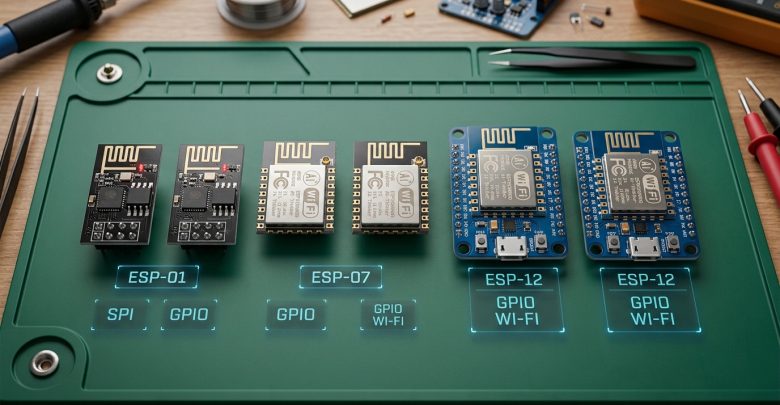
Selecting the right module depends on pin count, antenna requirements, and physical board space. The following table summarizes popular Ai-Thinker modules:
| Module | Active Pins | Form Factor | Antenna Type | Shielded | Flash Size |
|---|---|---|---|---|---|
| ESP-01 | 6 | 2×4 DIL | PCB Trace | No | 512 KiB |
| ESP-01S | 6 | 2×4 DIL | PCB Trace | No | 1 MiB |
| ESP-07S | 14 | 2×8 Pinhole | U.FL Socket | Yes | External |
| ESP-12 | 14 | 2×8 Castellated | PCB Trace | Yes | External |
| ESP-12E | 20 | 2×8 Castellated | PCB Trace | Yes | 4 MiB |
| ESP-12F | 20 | 2×8 Castellated | PCB Trace | Yes | 4 MiB |
| ESP-12S | 14 | 2×8 Castellated | PCB Trace | Yes | 4 MiB |
Critical Hardware Requirements for Standalone Deployment
Unlike NodeMCU breakout boards, standalone Ai-Thinker chips require specific external circuitry to boot reliably:
- Stable 3.3V Power Supply: ESP8266 microcontrollers are sensitive to current drops during Wi-Fi transmission spikes. Consequently, adding decoupling capacitors prevents random system resets.
- USB-to-Serial Converter: Programming raw firmware requires an external FTDI or CP2102 converter connected to the UART (TX/RX) pins.
- Pull-up/Pull-down Resistors: Configuring strapping pins (GPIO0, GPIO15, and CH_PD) ensures proper bootloader execution.
Final Technical Recommendations
- Best for Performance: Hardware engineers consider the ESP-12F the industry gold standard for production due to its optimized antenna layout, RF shielding, and 4 MiB Flash memory.
- Best for Space-Constrained Projects: The ESP-07S delivers an exceptionally small footprint with external U.FL antenna support for metal enclosures.
Conclusion
Transitioning from NodeMCU to standalone Ai-Thinker modules reduces product size and manufacturing cost. By designing clean 3.3V power regulation circuits and selecting the proper module form factor, engineers turn experimental breadboard circuits into robust, commercial-grade IoT products.