

ESP8266 is more than just a Wi-Fi chip; it is a full-fledged microcontroller that brought connectivity to the hobbyist electronics world. Since its introduction in 2014, it has revolutionized how we build smart devices.
Why Choose ESP8266?
- Affordability: Low cost compared to its feature set.
- Versatility: Functions as both a microcontroller and a Wi-Fi module.
- Active Community: Despite being relatively “young,” it has a massive global following.
Technical Specifications
The ESP8266 packs a surprising amount of power into a tiny package:
| Feature | Specification |
| Processor | Tensilica L106 32-bit |
| Clock Speed | 80 – 160 MHz |
| RAM | 32 KB + 80 KB |
| GPIOs | 17 pins (multiplexed) |
| ADC | 10-bit resolution |
| Connectivity | 802.11 b/g/n/d/e/i/k/r |
| Deep Sleep | ~10 µA (Great for battery-powered projects) |
Choosing Your Module: ESP-1 vs. ESP-12
While the core chip is tiny and hard to solder, “breakout” modules make it easy for developers to use:
1. ESP-12 (The Professional Choice)
- Pros: Access to the most GPIOs, highly flexible.
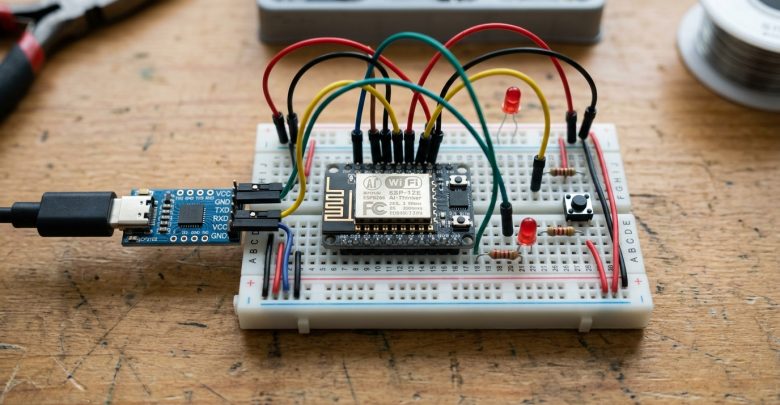
- Note: Requires an adapter (Expander) for breadboarding.
- Key Pins: Includes specific boot-mode pins (GPIO 0, 2, 15) that determine whether the device boots from Flash or enters programming mode.
2. ESP-1 (The Simple Choice)
- Pros: 8-pin layout, easy to plug into breadboards and microcontrollers.
- Cons: Limited GPIO access. Perfect for simple tasks like basic Wi-Fi bridging.
Critical Programming Insights
- Flash Memory Life: ESP8266 stores firmware in external Flash memory. It is rated for ~10,000 write/erase cycles. Avoid constant logging to Flash to preserve the module’s lifespan.
- AT Commands: The module is typically configured using the AT Command Set (similar to GSM modules like SIM900).
- Default Baud Rate: Commonly 115200 (if not working, try 9600).
- Communication: To configure the chip via PC, use a USB-to-Serial converter (FTDI). You only need the TX, RX, and GND pins to establish the link.
Pro-Tip: Battery Management
The ESP8266 is highly efficient in its Deep Sleep mode (10 µA). However, when transmitting Wi-Fi data, it can spike up to 170 mA. For battery-powered projects, design your software to spend the vast majority of time in sleep mode, waking only briefly to send data.
Tags: #ESP8266 #IoT #Microcontroller #Electronics #Arduino #SmartHome #Programming #WiFiModule