

The Internet of Things (IoT) landscape in 2026 is defined by rapid advancements in edge computing, non-terrestrial satellite networks, and AI-driven operational analytics. As enterprises transition from pilot projects to full-scale deployments, agile startups are solving critical industry bottlenecks—ranging from long-range wireless connectivity to real-time industrial cybersecurity.
This guide highlights notable IoT startups driving innovation across Industrial Automation, Next-Generation Connectivity, Fleet Logistics, and Cyber-Physical Security.
1. Industrial IoT (IIoT) & Smart Manufacturing
Industrial environments demand reliable data collection, real-time machine monitoring, and low-code integrations to reduce downtime.
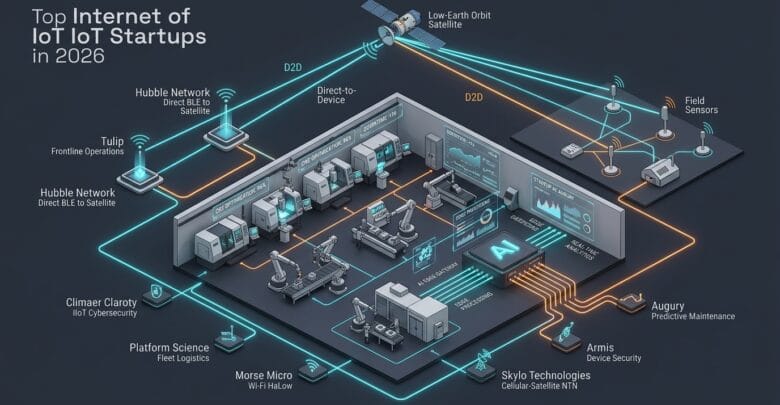
- Tulip Interfaces: Operates a frontline operations platform that enables manufacturers to build custom shop-floor applications. By connecting to IoT sensors, cameras, and industrial machinery, Tulip digitizes manual workflows without requiring complex software engineering.
- Datanomix: Delivers automated production monitoring designed for precision machining and CNC environments. Its platform extracts machine data to provide operational visibility without requiring manual input from machine operators.
- Augury: Combines artificial intelligence with IoT acoustic and vibration sensors to deliver predictive maintenance. By analyzing mechanical signatures, Augury helps identify equipment anomalies and anticipate hardware issues before they cause downtime.
2. Next-Gen Wireless Protocols & Satellite IoT
As deployment scale expands, traditional connectivity options can run into range or infrastructure limits. These startups are working on coverage gaps through silicon innovation and satellite integration.
- Morse Micro: Works on Wi-Fi HaLow (IEEE 802.11ah) silicon solutions. Their low-power chips are designed to extend wireless range well beyond standard Wi-Fi, aimed at use cases like smart agriculture, logistics hubs, and smart building management.
- Hubble Network: Developing technology aimed at connecting standard, off-the-shelf Bluetooth Low Energy (BLE) chips directly to satellite constellations via software updates, targeting cost-effective global asset tracking.
- Skylo Technologies: Provides Non-Terrestrial Network (NTN) connectivity, allowing standard cellular IoT modules and handheld devices to switch to satellite networks when outside terrestrial coverage.
3. Fleet Telematics, Mobility & Autonomous Logistics
Modern supply chains rely on spatial awareness and telemetry to help optimize route efficiency and asset safety.
- Platform Science: Provides an open telematics platform for commercial fleets, letting operators deploy compliance, driver safety, and asset-tracking software on a shared hardware architecture.
- Motive (formerly KeepTruckin): Integrates AI-powered dashcams, telematics gateways, and IoT environmental sensors to provide location tracking, fuel management, and safety alerts for logistics networks.
- DroneDeploy: Extends IoT into aerial and ground robotics. Its software platform supports autonomous drone flights and ground-rover data collection for site auditing in construction, agriculture, and utility infrastructure.
4. IoT Cybersecurity & Asset Visibility
The growth in connected devices expands the corporate attack surface. Securing unmanaged hardware and Operational Technology (OT) networks is a growing operational priority.
- Claroty: Delivers cybersecurity solutions for Cyber-Physical Systems (CPS) across industrial (OT), healthcare (IoMT), and commercial IoT deployments.
- Nozomi Networks: Works in OT and IoT security, providing AI-driven asset discovery, network monitoring, and threat intelligence for smart factories and critical infrastructure.
- Armis: Operates an agentless device security platform designed to discover, track, and secure connected devices—from legacy industrial controllers to modern smart building infrastructure.
Key Industry Trends Shaping IoT Startups in 2026
- Satellite-Direct-to-Device (D2D): Growing NTN integration is aimed at letting sensor nodes broadcast telemetry without multi-protocol gateways.
- Edge AI Processing: Microcontrollers with dedicated Neural Processing Units (NPUs) can process sensor data locally, which helps reduce latency and bandwidth usage.
- Zero-Trust Security Frameworks: Automated asset discovery and hardware-level root of trust are increasingly expected in enterprise IoT procurement.
Frequently Asked Questions (FAQ)
Q1: Why are Wi-Fi HaLow and Satellite IoT relevant for 2026 deployments?
Wi-Fi HaLow targets long-range, high-density indoor/outdoor connectivity needs, while Satellite IoT is aimed at providing coverage in rural, maritime, and remote environments where cellular networks are unavailable.
Q2: How do Industrial IoT startups aim to improve manufacturing ROI?
By helping factories move from reactive maintenance toward predictive maintenance approaches, with the goal of reducing unscheduled machine downtime and improving throughput.