
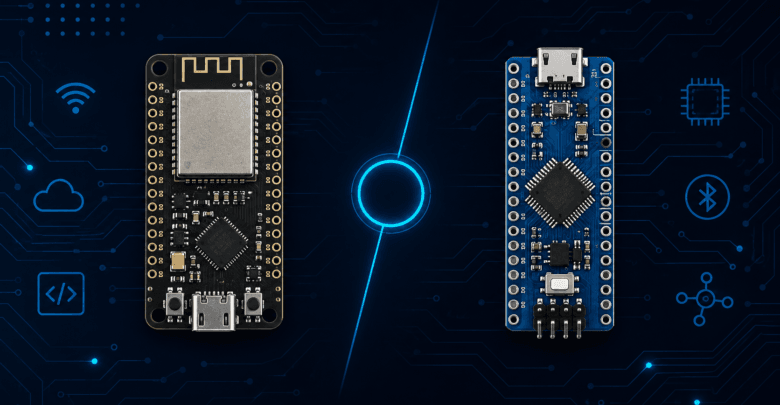
Walk into any IoT hobbyist forum and you’ll find the same question asked over and over: should I use an ESP32 or an ESP8266? Both chips come from the same manufacturer, Espressif, and both dominate the low-cost Wi-Fi microcontroller space. But they’re built for different jobs, and picking the wrong one can mean paying for features you don’t need — or hitting a wall halfway through your project because the board you chose can’t do what you need.
This guide breaks down the real differences between ESP32 and ESP8266, so you can make the right call before you buy.
Quick Overview: What Are ESP32 and ESP8266?
The ESP8266 launched first, back in 2014, and became famous almost overnight as an incredibly cheap way to add Wi-Fi to any project. It’s a single-core microcontroller with built-in Wi-Fi, and little else — no Bluetooth, limited GPIO, modest processing power. But at a price often under $3, it made Wi-Fi-connected projects accessible to anyone.
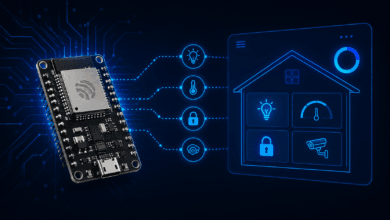
The ESP32, released in 2016, is Espressif’s more powerful follow-up. It keeps the low cost and built-in Wi-Fi, but adds a dual-core processor, Bluetooth (both Classic and BLE), more GPIO pins, and a wider range of peripherals — at a price still low enough for hobbyist and commercial use alike.
Processing Power and Memory
The ESP8266 runs a single-core processor at up to 80MHz (some variants reach 160MHz), with around 80KB of usable RAM. That’s enough for simple tasks: reading a sensor, connecting to Wi-Fi, sending data to a server.
The ESP32 runs a dual-core processor at up to 240MHz, with roughly 520KB of SRAM — several times more headroom than the ESP8266. This matters if your project needs to do more than one thing at once: running a web server while also reading sensors, handling Bluetooth and Wi-Fi simultaneously, or processing more complex logic without lag.
For a simple “read a sensor, send data” project, the ESP8266’s power is plenty. For anything with multiple simultaneous tasks, the ESP32’s extra cores and memory make a real difference.
Wi-Fi, Bluetooth, and Connectivity
Both chips include 802.11 b/g/n Wi-Fi, so either one connects to a standard home or office network without issue.
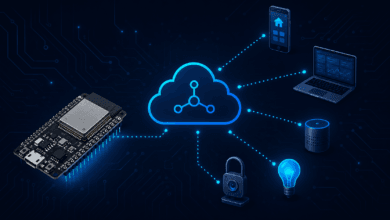
The key difference is Bluetooth. The ESP8266 has none. The ESP32 includes both Classic Bluetooth and Bluetooth Low Energy (BLE) — a major advantage for any project that needs to talk to a phone directly, without going through a Wi-Fi network first.
If your project needs a phone app to configure it, control it, or receive data from it over Bluetooth, the ESP32 is the only realistic choice between the two.
GPIO Pins and Peripherals
The ESP8266 gives you around 11 usable GPIO pins (fewer if you’re using certain built-in features that reserve specific pins), along with a single analog input.
The ESP32 offers considerably more — around 34 usable GPIO pins depending on the specific board, multiple analog inputs, and a wider set of built-in peripherals including capacitive touch sensing, a DAC (digital-to-analog converter), and more hardware timers.
If your project connects several sensors, displays, or actuators at once, the ESP32’s extra pins and peripherals save you from running out of connections partway through.
Power Consumption and Price
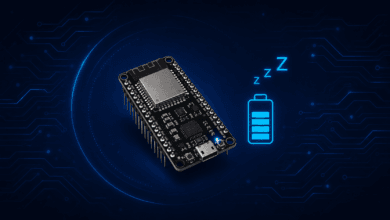
In active mode, the two chips draw roughly comparable power, though the ESP32’s extra cores and radios mean it can draw more under heavy load (especially with Bluetooth and Wi-Fi both active). In Deep Sleep, both chips can reach very low power draw, though achieving the ESP8266’s minimum typically takes less careful configuration since there’s simply less hardware to manage.
On price, the ESP8266 usually costs less — modules can run under $2 in bulk, while ESP32 modules typically start around $3–5 depending on the specific variant and features. For large-scale, cost-sensitive deployments where you only need Wi-Fi and basic processing, that price gap adds up.
Which Board Fits Which Project?
Choose the ESP8266 if:
- Your project just needs Wi-Fi and basic sensor reading or control — nothing more.
- You’re building at scale, and every dollar of unit cost matters.
- You don’t need Bluetooth, extensive GPIO, or heavy processing.
Choose the ESP32 if:
- You need Bluetooth (Classic or BLE) alongside Wi-Fi.
- Your project runs multiple tasks simultaneously — a web server plus sensor polling, for example.
- You need more GPIO pins for multiple sensors, displays, or peripherals.
- You want headroom for future features without redesigning your hardware.
For most new hobbyist projects today, the ESP32 has become the default choice — the price difference is small enough that the extra capability is usually worth it, even if you don’t need every feature right away. The ESP8266 still makes sense for extremely simple, cost-sensitive, high-volume projects where Wi-Fi is the only requirement.
Frequently Asked Questions
Can I run the same code on both ESP32 and ESP8266?
Not directly. While both are supported by the Arduino IDE and share some library compatibility, they use different underlying architectures (Xtensa LX106 for ESP8266, Xtensa LX6/LX7 for most ESP32 variants), and code that relies on ESP32-specific features (like BLE or the dual-core API) won’t run on an ESP8266 without modification.
Is the ESP32 backward-compatible with ESP8266 projects?
Mostly, at the concept level — Wi-Fi and basic sensor code translate reasonably well between the two with minor adjustments. But pin numbering, some library APIs, and hardware-specific features differ, so expect to make changes rather than a drop-in swap.
Which one is better for beginners?
Either works well for learning, but the ESP32 has become the more commonly taught and documented option today, given its wider feature set and popularity. If you’re just starting out and don’t have a specific cost constraint, the ESP32 is a reasonable default.
Conclusion
Neither board is objectively “better” — they’re built for different trade-offs between cost and capability. If your project is simple and Wi-Fi is all you need, the ESP8266 keeps things cheap and straightforward. If you need Bluetooth, more processing power, or more GPIO pins, the ESP32 is worth the small price premium.
Curious about what the ESP32 can do with its extra capabilities? Check out our guides on ESP32 Bluetooth Low Energy and ESP32 Deep Sleep for battery-powered projects — both cover features the ESP8266 simply doesn’t have.
For more hardware tutorials and modern embedded technology trends, explore our complete IoT Magazine collection.