10 Tech Trends Shaping the Future of Smart Devices and IoT
The rapid convergence of hardware, connectivity, and artificial intelligence is fundamentally transforming the electronics landscape. Today, smart devices are no longer isolated gadgets. Instead, they act as interconnected nodes driving the global digital transformation. In this article, we explore ten critical technology trends that are actively shaping the future of the Internet of Things (IoT) and embedded engineering.
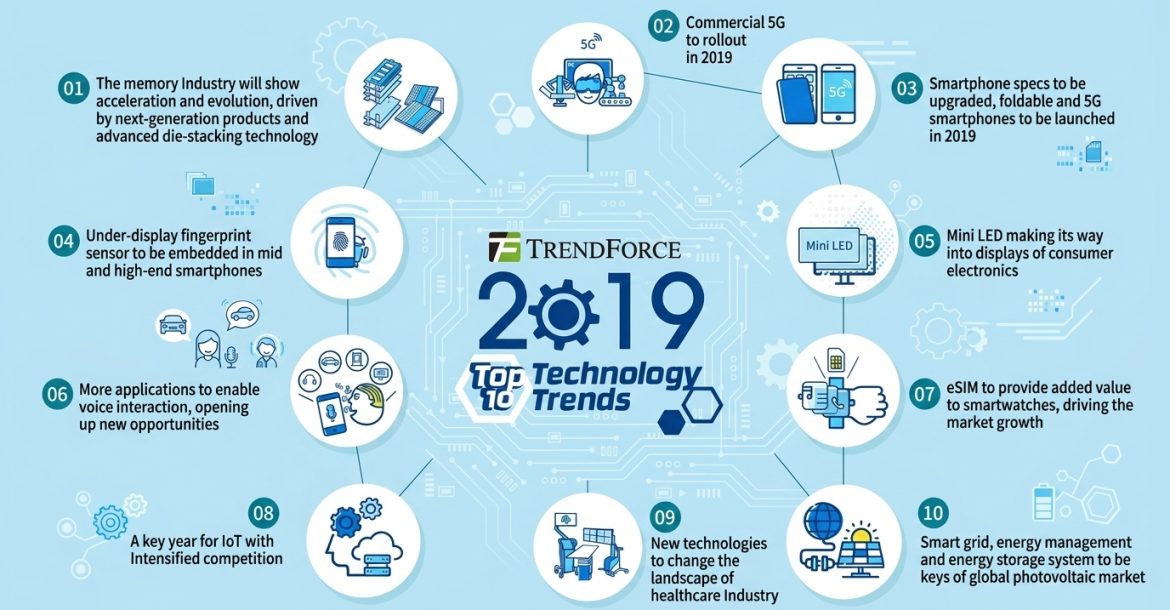
1. Advancements in the Memory Industry
Modern Edge AI applications demand ultra-fast data access directly on embedded chips. Consequently, advancements in high-bandwidth memory (HBM) and low-power NOR/NAND flash are enabling microcontrollers to process complex machine learning models locally with minimal latency.
2. Expansion of 5G Internet
5G networks are expanding far beyond consumer smartphones. Furthermore, technologies like 5G RedCap (NR-Light) and C-V2X are providing low-latency, high-bandwidth connectivity for industrial automation, autonomous vehicles, and smart city infrastructure.
3. Development of Smartphone Capabilities
Smartphones are evolving into powerful edge gateways. With upgraded NPU architectures and spatial awareness sensors, modern mobile devices now act as central hubs for managing smart home ecosystems, wearable diagnostics, and industrial IoT nodes.
4. Increased Adoption of Fingerprint Sensors in Smartphones
Biometric security is expanding rapidly across consumer and industrial hardware. Advanced optical and ultrasonic fingerprint sensors are setting new standards for physical authentication, secure mobile payments, and hardware access control.
5. Rise of Small Displays in Electronic Devices
Compact OLED and TFT displays are becoming standard features in modern embedded products. From micro-smartwatches to industrial sensor nodes, small displays enhance user experience by delivering real-time status updates directly at the edge.
6. Expansion of Voice Control Capabilities
Voice user interfaces (VUI) are shifting from cloud-dependent servers to local processing. Thanks to TinyML and dedicated audio DSPs, smart devices now process voice commands offline, dramatically improving user privacy and operational speed.
7. Growth of Wearables with eSIM Integration
The wearable technology market is experiencing explosive growth due to cellular eSIM integration. As a result, smartwatches and health trackers no longer require a companion phone, enabling continuous, independent cloud connectivity.
8. Increased Competition in the IoT Sector
The Internet of Things market is maturing rapidly. As a consequence, open connectivity standards like Matter and Thread, alongside protocols like LoRaWAN, are competing to provide seamless interoperability across diverse smart devices.
9. Healthcare Tech Progress (IoMT)
The Internet of Medical Things (IoMT) is revolutionizing patient care. Connected medical devices, continuous glucose monitors, and wearable telemetry now transmit critical health metrics directly to healthcare providers in real time.
10. Energy Management & Solar Tech Development
Sustainable electronics are essential for massive IoT deployments. Consequently, innovations in energy harvesting and ultra-low-power microcontrollers allow modern IoT devices to run for years using small solar cells and ambient light.
Conclusion
These ten technological advances are building the foundation for fully autonomous and connected ecosystems. Staying ahead in the IoT industry requires embracing these trends to design smarter, more efficient hardware solutions.