
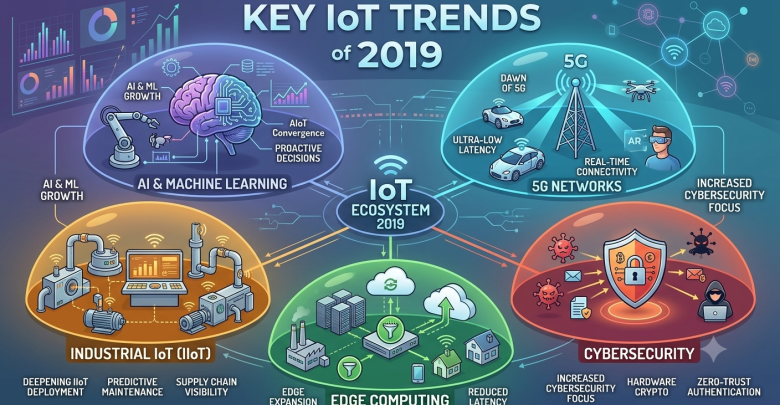
The rapid expansion of the Internet of Things (IoT) network has brought about profound changes across various industries, creating major shifts in businesses and everyday life. In 2019, several key trends emerged that redefined the future of connected devices and corporate investments in hardware and smart platforms.
1. The Growth of Artificial Intelligence (AI) and Machine Learning
In 2019, the convergence of AI and IoT—often referred to as AIoT—gained substantial momentum. Rather than just collecting raw data, IoT devices began leveraging advanced machine learning algorithms to analyze information on-the-fly, enabling:
- Proactive Decision-Making: Processing complex environmental inputs without requiring human intervention.
- Automated Threat Detection: Identifying operational anomalies in real time to prevent system breaches.
- Personalized User Experiences: Adapting automated responses based on historical user behavior patterns.
2. The Dawn of 5G Networks
The commercial rollout of 5G technology in 2019 laid the foundation for the next generation of wireless communication. With ultra-low latency and massive bandwidth capacities, 5G solved the core communication bottleneck for millions of IoT devices, paving the way for data-heavy applications:
- Autonomous Driving: Enabling instantaneous Vehicle-to-Everything (V2X) sensor communication.
- Real-Time Remote Surgery: Providing sub-millisecond response times for mission-critical telemedicine systems.
3. Deepening Industrial IoT (IIoT) Deployment
Manufacturing facilities, energy grids, and logistics operations significantly increased their adoption of the Industrial Internet of Things:
- Predictive Maintenance: Sensors deployed on factory floors monitored machine vibration and temperature to anticipate equipment failure before it occurred.
- Supply Chain Optimization: Fleet tracking modules provided end-to-end visibility over inventory transit and cargo conditions in real time.
2019 IoT Trends Comparison Matrix
The table below contrasts the core functional focus and primary impact of each major trend from 2019:
| IoT Trend | Functional Focus | Primary Operational Impact |
|---|---|---|
| Artificial Intelligence (AIoT) | On-device machine learning analytics | Transforms raw sensor data into automated, predictive insights |
| 5G Networks | Ultra-low latency & high-bandwidth connectivity | Enables real-time, data-heavy applications like autonomous transit |
| Industrial IoT (IIoT) | Fleet tracking & machine telemetry monitoring | Maximizes factory uptime through predictive maintenance |
| Cybersecurity Focus | Hardware-level chips & Zero-Trust protocols | Protects connected entry points against botnets & breach vectors |
| Edge Computing | Local node data processing & gateway filtering | Reduces cloud latency and bandwidth consumption costs |
4. Increased Focus on IoT Cybersecurity
As the number of connected entry points grew exponentially, security became a top priority in 2019. Facing severe threat vectors and botnets, vendors shifted from treating data security as an afterthought to embedding robust hardware-level security mechanisms:
- Hardware Cryptographic Chips: Integrating dedicated security modules directly onto system boards.
- End-to-End Encryption: Securing communication pipelines across perception, network, and cloud layers.
- Zero-Trust Authentication: Verifying every node identity continuously before authorizing network access.
5. The Expansion of Edge Computing
To reduce reliance on distant cloud data centers, 2019 saw a major shift toward edge computing. By processing and filtering data directly on local network nodes or gateways closer to the source, organizations achieved critical performance gains:
- Lower Latency: Accelerating response times for time-sensitive IoT applications.
- Bandwidth Savings: Filtering redundant raw data locally before transmitting processed summaries to the cloud.
- Offline Resilience: Ensuring continuous local network operations even during internet disconnections.
Conclusion
In conclusion, the 2019 IoT landscape marked a major transition from basic connectivity to intelligent, decentralized ecosystems. Ultimately, combining edge processing, 5G speeds, and hardware security created resilient platforms capable of supporting critical modern applications.