

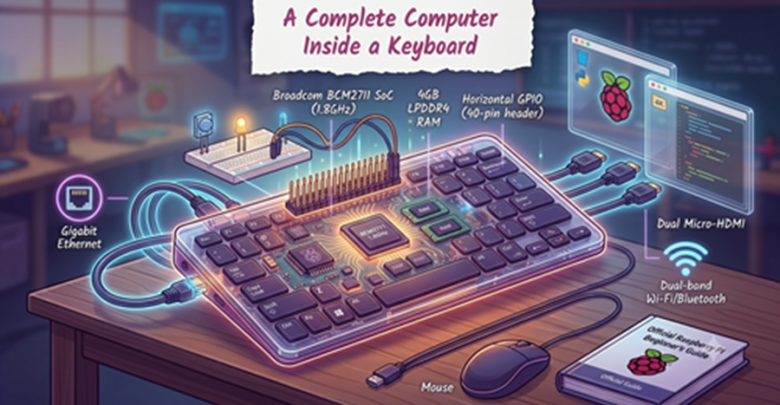
The Raspberry Pi 400 represents a highly practical, all-in-one personal computer designed by the Raspberry Pi Foundation. What makes this device truly unique is its integrated form factor: a compact, fully functional computer built seamlessly directly inside an official Raspberry Pi keyboard.
Consequently, if you want an affordable, portable, and efficient solution for coding, daily office tasks, or embedded electronics engineering, the Raspberry Pi 400 provides an outstanding choice.
Key Technical Specifications
The Raspberry Pi 400 packs robust personal computing hardware directly behind its full physical keybed:
- High-Clocked Processor: Broadcom BCM2711 quad-core Cortex-A72 (ARM v8) 64-bit SoC running at 1.8GHz (slightly faster out-of-the-box than the standard Raspberry Pi 4).
- System Memory: 4GB LPDDR4-3200 high-speed RAM.
- Wireless Connectivity: Dual-band (2.4GHz and 5.0GHz) IEEE 802.11b/g/n/ac wireless LAN and Bluetooth 5.0 (BLE).
- High-Speed Networking: Integrated Gigabit Ethernet port for fast local network throughput.
- Peripheral Ports & Expansion:
- 2 × USB 3.0 ports and 1 × USB 2.0 port.
- Horizontal 40-pin GPIO header accessible directly at the back panel.
- 2 × micro-HDMI ports (supporting dual 4K resolution displays at 60Hz).
- MicroSD card slot for operating system storage and project data.
Primary Advantages of the Raspberry Pi 400
- All-in-One Desktop Form Factor: You no longer require a separate computer case, external keyboard, or messy desktop wiring. Simply connect a mouse, USB-C power supply, and monitor to start working immediately.
- Passive Thermal Management: Thanks to an internal large metal heat sink, the Pi 400 handles heavy CPU workloads smoothly and operates 100% silently without requiring an active cooling fan.
- Ideal for STEM Education and Coding: The Pi 400 serves as a budget-friendly workstation for students and developers learning Python, C++, or Linux system administration.
- Hardware Expansion Friendly: Direct access to the rear 40-pin GPIO header allows developers to attach hardware sensors, breadboards, and expansion modules effortlessly without opening a case.
Key Limitations to Consider Before Buying
- Fixed RAM Configuration: Unlike standalone Raspberry Pi boards, you cannot choose different memory variants, as it comes exclusively in a 4GB RAM model.
- No Ribbon Cable Connectors: The board lacks dedicated CSI (Camera) and DSI (Display) ribbon cable ports. Therefore, you must use USB webcams or HDMI displays instead.
Raspberry Pi 400 vs. Standard Single Board Computers
The following table summarizes the primary differences between the Raspberry Pi 400 and traditional single-board computers:
| Feature | Raspberry Pi 400 | Standard Raspberry Pi 4 (SBC) |
|---|---|---|
| Form Factor | Integrated Keyboard Case | Bare Circuit Board (SBC) |
| Out-of-the-Box CPU Speed | 1.8 GHz | 1.5 GHz (Upgradeable via Firmware) |
| Cooling System | Built-in Heavy Metal Heat Sink | Requires External Passive/Active Cooler |
| GPIO Pin Access | Rear Horizontal Header | Vertical Top Pins |
| CSI/DSI Ports | Not Available | Supported |
Available Retail Purchasing Options
The Raspberry Pi 400 is available in two distinct retail packaging choices:
- Unit Only Kit: Contains solely the integrated keyboard computer itself.
- Full Personal Computer Kit: Includes the Raspberry Pi 400 keyboard computer, official USB optical mouse, USB-C power supply, micro-HDMI to HDMI cable, pre-programmed microSD card with Raspberry Pi OS, and the official Beginner’s Guide book.
For a broader breakdown of how the Pi 400 compares against the broader hardware ecosystem (including the Pi 5 and Pi Zero 2 W), explore our Raspberry Pi 2026 Ecosystem Overview.
Conclusion
The Raspberry Pi 400 converts standard single-board computing into an accessible, plug-and-play desktop experience. By pairing a 1.8GHz processor with silent passive cooling and accessible GPIO pin headers, it delivers an exceptional workstation for coders, educators, and electronics enthusiasts worldwide.