
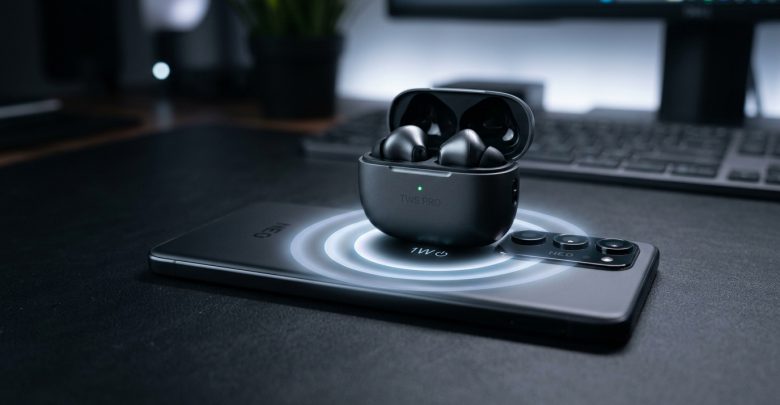
A significant technological leap in wireless power transfer has emerged: NFC Wireless Charging (WLC). This innovation allows smartphones to charge small, low-power gadgets using existing NFC hardware, eliminating the need for bulky, dedicated wireless charging components inside compact devices.
Consequently, NFC Wireless Charging converts everyday smartphones into versatile power hubs for next-generation wearables.
What is NFC Wireless Charging (WLC)?
Unlike traditional high-wattage wireless charging standards (like Qi) designed for smartphones, WLC via NFC targets the Low-Power Internet of Things (IoT) ecosystem.
- Targeted Power Output: WLC delivers approximately 1 Watt of continuous power. While not intended for fast-charging smartphones, this wattage perfectly sustains small electronics.
- Hardware Efficiency: The protocol leverages existing NFC antennas already present in modern smartphones. Therefore, manufacturers enable power transmission without adding heavy extra coils.
- Ideal Target Devices: WLC powers small-form-factor gadgets, including True Wireless Stereo (TWS) earbuds, fitness bands, stylus pens, and health trackers.
Why WLC Transforms IoT Device Design
Implementing WLC via NFC offers major engineering advantages for hardware manufacturers and end users alike:
- Substantial Cost Reduction: By utilizing the existing NFC chip, manufacturers remove expensive, dedicated wireless charging receiver modules.
- Internal Space Optimization: Removing bulky charging hardware frees up critical space inside tiny wearables. Engineers can utilize this extra room for larger batteries or additional environmental sensors.
- Simplified Charging Ecosystem: Smartphones act as universal charging pads for accessory ecosystems, eliminating extra proprietary charging cables.
Qi Wireless Charging vs. NFC Wireless Charging (WLC)
The following table summarizes the key structural differences between standard Qi charging and NFC WLC:
| Feature | Standard Qi Wireless Charging | NFC Wireless Charging (WLC) |
|---|---|---|
| Power Output Range | 5W to 15W+ (Fast Charging) | Up to 1 Watt (Trickle Charging) |
| Required Hardware | Dedicated Large Induction Coils | Existing NFC Antenna |
| Primary Target | Smartphones & Large Tablets | Wearables, TWS Earbuds & IoT Sensors |
| Space Footprint | Large & Heavy | Ultra-Compact / Zero Additional Space |
The Strategic Shift in Smartphone Design
According to recent mobile engineering reports, NFC WLC represents a major design paradigm shift. Smartphone manufacturers can now provide reverse wireless charging for accessories without integrating complex, heavy reverse-induction systems.
By transforming the NFC antenna into a dual-purpose component for both communication and power transfer, the industry advances toward:
- Sleeker, lighter wearable devices.
- Lower production costs for IoT accessories.
- A streamlined, interconnected consumer hardware ecosystem.
Conclusion
While NFC Wireless Charging will not replace traditional high-wattage phone chargers, it provides the missing piece for the IoT landscape. By enabling seamless power transfer for compact wearables, WLC makes digital ecosystems lighter, more efficient, and truly interconnected.