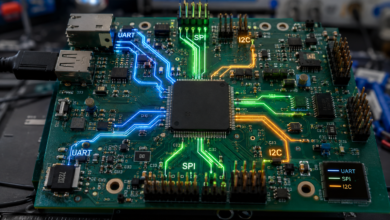



Connecting billions of smart devices requires a unified architecture across hardware, networking, and software stacks. Consequently, international standards organizations define protocols at distinct operational layers to ensure interoperability and security.
Here is a structured overview of essential Internet of Things (IoT) standards and protocols, categorized by their primary operational domain.
1. Communication and Transport Layer Protocols
The transport layer defines physical and radio protocols for moving data payloads across short-range personal networks and wide-area industrial grids:
Short-Range and Mesh Wireless Protocols
- Ethernet: Standard wired networking technology providing reliable local data connectivity.
- IEEE 802.15.4: Defines physical and media access layers for Low-Rate Wireless Personal Area Networks (LR-WPANs). Consequently, it serves as the underlying foundation for ZigBee, WirelessHART, and ISA100.11a.
- ZigBee: Utilizes IEEE 802.15.4 at 2.4 GHz, supporting mesh networks up to 1,024 nodes with 128-bit AES encryption.
- WirelessHART & ISA100.11a: Robust industrial wireless protocols built specifically for process control and asset monitoring.
- DigiMesh: A proprietary peer-to-peer wireless mesh topology simplifying node layout management.
- Bluetooth & Eddystone: Operates in the 2.4 GHz spectrum using frequency hopping. Eddystone defines Bluetooth Low Energy (BLE) message formats for proximity broadcasting.
- NFC: Based on ISO/IEC 18092:2004, offering high-security inductive communication at 13.56 MHz for short-range data exchange.
- ANT: A proprietary wireless sensor network protocol operating in the 2.4 GHz ISM RF band to manage automated node pairing.
- EnOcean: An energy-harvesting wireless standard operating at 868 MHz (Europe) and 315 MHz (North America) for building automation.
- WiMax (IEEE 802.16): Broadband wireless protocol offering wide-area coverage up to 50 km for stationary base stations.
LPWAN and Cellular IoT Protocols
- Weightless: An open LPWAN technology standard using TV whitespace channels to connect thousands of low-power nodes.
- NB-IoT & LTE-MTC: 3GPP-standardized cellular IoT protocols engineered for high signal penetration and minimal energy consumption.
- EC-GSM-IoT: Extended Coverage GSM technology upgrading legacy cellular base stations via software updates.
- LoRaWAN: A long-range, low-power protocol designed for battery-powered sensors across regional networks.
- RPMA: Random Phase Multiple Access system utilizing Direct Sequence Spread Spectrum (DSSS) algorithms.
2. Semantic and Data Description Standards
Semantic standards provide common data formats, enabling diverse platforms to interpret sensor measurements correctly:
- IOTDB: JSON and Linked Data standards used to describe connected hardware and environments.
- SensorML: Standard XML encodings used to describe measurement processes and sensor hardware characteristics.
- Semantic Sensor Net Ontology (W3C): Describes sensors, observations, and physical concepts using OWL ontologies.
- Wolfram Language (Connected Devices): Symbolic representation connecting devices directly with computational functions like
DeviceReadandDeviceExecute. - RAML: RESTful API Modeling Language that simplifies API design lifecycle management.
- SENML: Sensor Markup Language enabling simple sensors to transmit measurements over HTTP or CoAP.
- LsDL: Lemonbeat Smart Device Language, an XML-based language tailored for service-oriented devices.
3. Multi-Layer Interoperability Frameworks
Frameworks unify communication, resource discovery, and API interfaces across fragmented hardware ecosystems:
- AllJoyn & IoTivity: Open-source frameworks enabling cross-brand device discovery and interaction under Open Connectivity Foundation (OCF) guidelines.
- IEEE P2413: Standard defining an overarching architectural framework for global IoT deployments.
- Thread: Built on open IPv6 and 6LoWPAN standards to manage reliable mesh networks inside smart homes.
- IPSO Application Framework: Defines REST interfaces exposing smart object resources directly to cloud applications.
- OMA LightweightM2M (LwM2M): Efficient device management protocol designed for M2M communication over low-bandwidth networks.
- Weave: Google communication platform facilitating mobile setup, device-to-device messaging, and web interactions.
- Telehash: Decentralized overlay network protocol securing device communication via JSON, UDP, and distributed hash tables.
4. Hardware and Network Security Protocols
Robust security frameworks protect hardware identities and encrypted communications against cyber threats:
- Open Trust Protocol (OTrP): Manages application installations and security profiles inside a Trusted Execution Environment (TEE).
- X.509: Public Key Infrastructure (PKI) standard managing digital certificates to authenticate web nodes and transport encryption.
5. Vertical-Specific Industrial Standards
Industry-specific standards govern niche sensor integration and infrastructure management:
- IEEE 1451: Family of smart transducer interfaces connecting sensors and actuators to digital microprocessors.
- IEEE 1888.3-2013: Security standard tailored for ubiquitous green community control networks.
- IEEE 1905.1-2013: Convergent digital home network standard integrating heterogeneous connectivity technologies.
- IEEE 1377-2012: Utility industry application layer protocol defining smart grid communication interfaces.
- IEEE P1856: Framework standard for electronic system health management and fault prevention.
Conclusion
Understanding the multi-layered ecosystem of IoT protocols enables engineers to build scalable, secure, and future-proof connected systems. Selecting the correct combination of transport protocols, semantic formats, and security standards ensures seamless deployment across both commercial and industrial environments.