

Public safety communications and solutions are evolving rapidly to meet modern requirements. Cities need to deploy cutting-edge technologies and manage equipment in an integrated manner. Furthermore, organizations must provide diverse public safety services across every stage of the crisis management lifecycle.
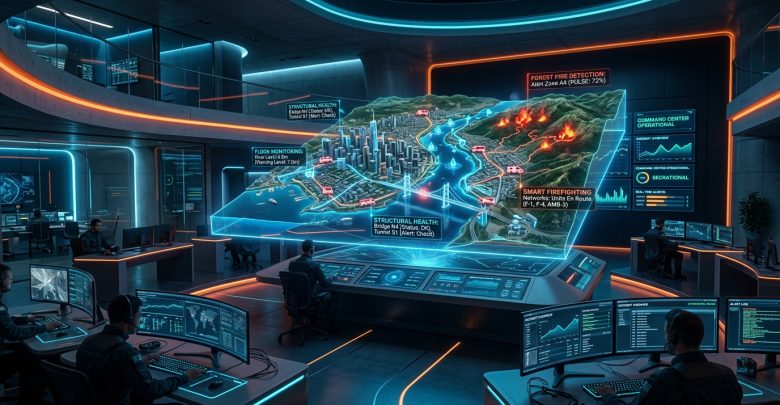
By monitoring conditions in real time, command centers establish instant communication between citizens, field units, and rescue organizations. Taking into account the four phases of crisis management—mitigation, preparedness, response, and recovery—technologies like the Internet of Things (IoT), private radio networks, and LTE build integrated safety ecosystems.
1. Smart Forest Fire Detection
Forest ecosystems face severe threats from wildfires. Consequently, these disasters cause negative ecological, economic, and social impacts. The most effective way to minimize damage involves early detection during initial stages to prevent fire spread.
- Gas Spectrum Analysis: Primary detection systems analyze atmospheric gas spectra and compare telemetry against fire-generated profiles.
- IoT Complementary Sensors: Field teams deploy supplementary IoT sensor grids in sensitive forest zones. Therefore, managers maintain tighter monitoring over high-risk areas.
2. Smart Flood Detection and Early Warning
Floods represent one of the most common natural disasters globally. Establishing timely early warning systems plays a vital role in reducing flood risks. Consequently, smart flood solutions manage risks before, during, and after events occur.
Key System Capabilities:
- Precise Monitoring: Sensor nodes capture water levels, flow rates, and rainfall volume continuously.
- Predictive Algorithms: Systems combine real-time sensor data with historical records and meteorological data to forecast flood paths.
- Automated Alerts: Control panels trigger automated alerts the moment parameters exceed critical safety thresholds.
- Real-Time Visualization: Command centers display exact incident locations instantly. As a result, rescue teams deploy faster.
- Personnel Tracking: Fleet tracking systems monitor emergency vehicles and rescue workers. Furthermore, biometric wearables monitor field personnel health parameters to ensure worker safety.
3. Smart Infrastructure and Structural Health Monitoring
Infrastructure failures caused by material fatigue, earthquakes, or weather extremes impact public safety heavily. Therefore, city managers prioritize urban resilience by monitoring critical structures like tunnels, mines, bridges, and mountain passes.
System Operation and Features:
- Geotechnical Sensor Arrays: Distributed sensors measure structural tilt, vibration, strain, and displacement in real time.
- AI and Big Data Processing: Cloud platforms process incoming telemetry to predict structural hazards and prevent catastrophic failure.
- Plug-and-Play Architecture: Engineers install modular sensor nodes anywhere without complex wiring.
- Low-Power Communication: Hardware utilizes long-range, low-power protocols like LoRaWAN to ensure reliable data transfer over miles.
- Automated Reporting: Analytical tools generate structural health reports and alert supervisors to rockfalls or road blockages instantly.
4. Smart Firefighting and Urban Incident Management
Recent urban fires emphasize the necessity of real-time incident management. Maintaining situational awareness between field units and central command centers paves the way for modern, proactive safety practices.
By linking environmental sensors, smart building alarms, and field telemetry, emergency services orchestrate rapid responses. Ultimately, connected crisis management systems reduce response times, protect physical assets, and save human lives.
Conclusion
Modern crisis management relies heavily on connected data networks. Integrating IoT sensors, predictive AI algorithms, and broadband LTE allows municipalities to mitigate risks effectively. Ultimately, building intelligent public safety platforms turns vulnerable cities into resilient smart environments.