


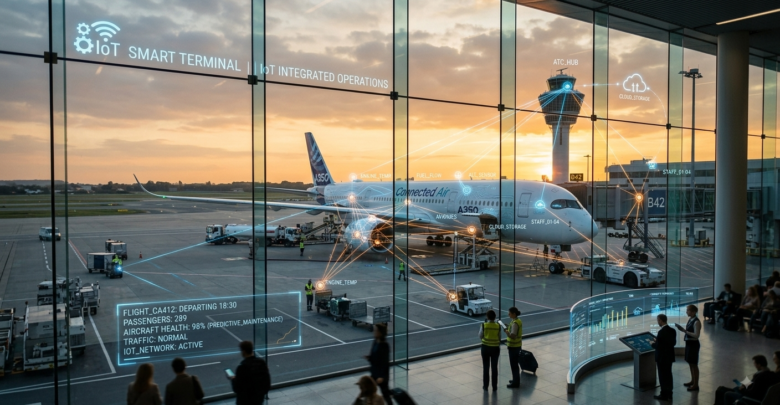
The aviation industry is no stranger to technological innovation. However, we are currently witnessing its most profound shift yet. This digital transformation is driven primarily by the Internet of Things (IoT). While connected aircraft and smart airports are no longer just buzzwords, they represent the foundation of a rapidly expanding airline IoT market.
This guide provides a comprehensive analysis of how IoT in aviation is revolutionizing the industry. Furthermore, we will explore how it optimizes airline operations and enhances passenger safety.
What is IoT in Aviation?
Simply put, IoT in Aviation refers to a vast network of connected physical objects. These include sensors, actuators, and smart devices embedded within aircraft components, airport infrastructure, and luggage systems. Consequently, these objects continuously collect and exchange massive amounts of real-time data over the internet.
As a result, this connectivity enables airlines to monitor assets remotely. In addition, it helps automate processes, predict potential issues, and make data-driven decisions that were once impossible.
Key Segments Driving the Airline IoT Market Growth
The modern airline is not just one entity. Instead, it operates as a complex ecosystem. Today, IoT is penetrating every corner of this ecosystem. We can categorize this growth into three primary segments:
1. In-Flight IoT and Connected Aircraft
This segment is the heart of the market. Sensors on commercial aircraft engines, fuel systems, and structural components constantly transmit performance data. Therefore, this connectivity facilitates Real-time Monitoring. Moreover, it enables the game-changing practice of Predictive Maintenance. Simultaneously, it powers high-speed in-flight Wi-Fi and advanced entertainment systems for passengers.
2. Smart Airports and Ground Operations
The passenger journey always begins at the terminal. Thus, IoT in airports includes beacons for indoor navigation and biometric scanning for boarding. Additionally, autonomous ground vehicles and automated Baggage Tracking systems significantly reduce lost luggage rates.
3. Smart Asset Management and Logistics
Beyond the aircraft, airlines manage millions of physical components. Consequently, IoT helps track parts across the supply chain. In addition, it manages inventory efficiently to ensure assets are always available when needed.
The Value Proposition: Why Airlines are Investing Heavily
The driving force behind IoT adoption is not just novel technology. Instead, it is the undeniable return on investment (ROI). Airlines constantly face immense pressure regarding profit margins and safety protocols. Fortunately, IoT directly addresses these pain points.
A. Operational Efficiency and Cost Reduction
This is the primary financial driver. By making operations leaner, IoT significantly impacts an airline’s bottom line.
- Fuel Optimization: IoT sensors analyze flight data in real-time to optimize routes and reduce engine idle time. Therefore, airlines achieve massive savings on fuel, which remains their largest operating cost.
- Streamlined Ground Handling: Sensors on fuel trucks and ground equipment synchronize ground processes. As a result, gate turnaround times decrease, preventing costly operational delays.
B. Safety and Predictive Maintenance (The Game Changer)
Traditionally, maintenance was reactive or scheduled. However, Predictive Maintenance powered by IoT changes everything.
Sensors constantly monitor the exact health of critical parts like turbine blades. By analyzing this real-time data, airlines can predict when a part might fail. Consequently, technicians replace components before any malfunction occurs.
- Impact on Safety: First, this proactive approach dramatically reduces the risk of mechanical failures.
- Impact on Revenue: Second, it prevents Unscheduled Maintenance Dispatches. Thus, airlines save billions of dollars annually in lost revenue and passenger compensation.
C. Transforming the Passenger Experience
In today’s competitive landscape, passenger satisfaction is paramount. Therefore, IoT is key to personalizing the travel journey.
- Seamless Travel: IoT-enabled biometrics speed up movement through security and boarding gates.
- Personalized Service: Furthermore, in-flight systems adjust content recommendations based on passenger preferences.
- Peace of Mind: Finally, real-time baggage tracking apps provide exact luggage locations, which significantly reduces travel anxiety.
Market Outlook: Airline IoT Market Size and Forecast
The airline IoT market is expanding rapidly. Market research consistently forecasts robust double-digit growth.
- Current Estimates: As of 2024, the global aviation IoT market is already valued in the low billions of dollars.
- Growth Forecast: Furthermore, analysts predict the market will maintain a Compound Annual Growth Rate exceeding 20 percent. Consequently, projections surpass 20 Billion USD by 2030.
This staggering growth is fueled by cheaper sensors and advancing satellite connectivity. In addition, the global push toward greener aviation accelerates this demand.
Key Players and Industry Innovations
Several prominent companies are leading this revolution. They range from established aerospace corporations to specialized tech firms.
- Aerospace Giants: SITA, Honeywell Aerospace, Collins Aerospace, and GE Aviation are pioneers in integrated connected aircraft solutions.
- Tech and Connectivity Leaders: Similarly, companies like Huawei, Cisco, SAP, and Amadeus provide robust networking infrastructure and data analytics platforms.
These players are constantly innovating. For instance, they develop smarter sensors and integrate advanced Artificial Intelligence (AI) to make IoT data even more predictive and actionable.
Challenges and Future Considerations
While the promise is immense, several challenges remain:
- Data Security and Privacy: The vast amount of transmitted data makes the industry a prime cyberattack target. Therefore, robust cybersecurity protocols are essential.
- High Initial Investment: Developing IoT infrastructure requires significant upfront capital. Consequently, this creates a barrier for smaller airlines.
- Interoperability: Ensuring different sensors and platforms communicate seamlessly remains a persistent technical challenge.
Conclusion
In conclusion, the airline IoT market is not a passing trend. Instead, it is the fundamental cornerstone of next-generation aviation. By harnessing the power of data, IoT enables airlines to become smarter, safer, and more efficient than ever before.