


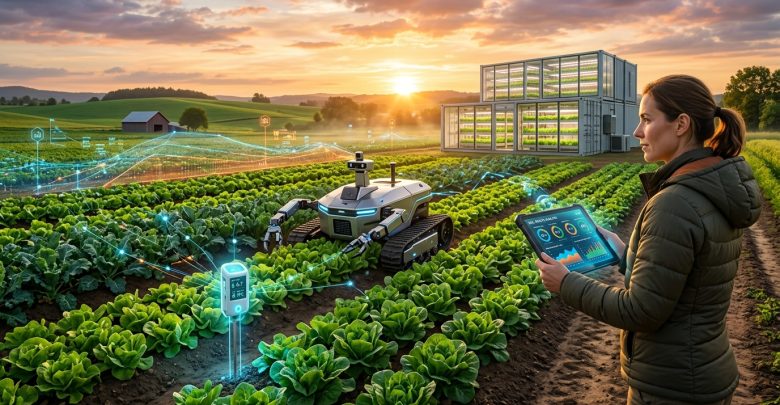
In modern farming, smartphones and tablets have become as essential as the plow. Leveraging the Internet of Things (IoT), farmers now monitor critical field variables in real time, such as soil moisture, micro-climatic shifts, and nutrient levels.
Consequently, adopting data-driven technologies transforms traditional agriculture into an efficient, sustainable, and predictable system. Here are five key AgriTech innovations reshaping global food production.
1. Precision Agriculture and Data-Driven Field Management
Precision tools give farmers unprecedented visibility over crop health. For example, systems like the Arable PulsePod use six-band spectrometers to measure rainfall, leaf moisture, and environmental stress accurately.
- Predictive Yields: Real-time data streams help agronomists predict future crop yields precisely.
- Risk Mitigation: Farmers adjust irrigation schedules early to mitigate drought risks and prevent food supply shocks.
2. Urban and Controlled-Environment Indoor Farming
Urban agriculture currently accounts for approximately 20% of global food production. Technology makes growing high-quality produce inside dense cities possible with minimal environmental footprints.
- Smart Home Farming: Automated systems allow consumers to control indoor lighting, water pumps, and nutrient dosing directly via smartphone apps.
- Container Farming: Freight Farms converts shipping containers into mobile growing environments. Using IoT platforms, operators monitor CO2 levels, humidity, and temperature remotely.
3. Automated Insect Farming and Alternative Nutrition
Meeting the global demand for sustainable protein requires innovative production methods. Consequently, technology is optimizing the scalable farming of edible insects.
For instance, AgriTech startups use distributed sensors and data logging apps to monitor insect population health. This automated tracking ensures hygienic production while maximizing feed conversion rates.
4. Agricultural Robotics and Labor Automation
Demographic shifts show an aging agricultural workforce globally. Consequently, intelligent field robotics step in to handle repetitive and physically demanding tasks.
Modern agricultural robots perform automated weeding, precision harvesting, and targeted spraying. Therefore, replacing manual labor with autonomous machinery solves labor shortages and increases field productivity.
5. Overcoming Infrastructure Costs with NB-IoT Connectivity
High infrastructure costs previously delayed widespread AgriTech adoption. However, Narrowband IoT (NB-IoT) connectivity lowers deployment barriers significantly.
- Deep Network Coverage: NB-IoT provides strong signal coverage across deep basements, urban warehouses, and remote fields.
- Extreme Energy Efficiency: Low-power NB-IoT sensors operate on battery power for years without maintenance. Consequently, connecting sprawling farmlands becomes economically viable.
Conclusion
AgriTech goes beyond adopting modern gadgets; it solves the fundamental challenges of modern agriculture. By saving water, optimizing fertilizer usage, and reducing manual labor, connected technologies offer a sustainable path forward. As NB-IoT connectivity expands, data-backed decision-making becomes the global standard for modern farming.