

Standard Ethernet was never built with factory floors in mind. It handles data on a best-effort basis, which works fine for email and file transfers. But it falls apart when a robotic arm needs a control signal to arrive within a guaranteed microsecond window, every single time. Time-Sensitive Networking (TSN) closes that gap. It brings deterministic, real-time performance to standard Ethernet hardware, rather than requiring proprietary industrial networking altogether.
This guide covers what TSN actually is, how it differs from standard Ethernet and older industrial Ethernet variants, and why it’s becoming a foundational piece of modern industrial network architecture.
The Problem TSN Solves
Standard Ethernet, the kind running office networks everywhere, uses a “best-effort” delivery model. Data packets get sent and generally arrive quickly, but there’s no hard guarantee about exact timing. A packet might occasionally get delayed by network congestion, and for most applications, that’s perfectly fine.
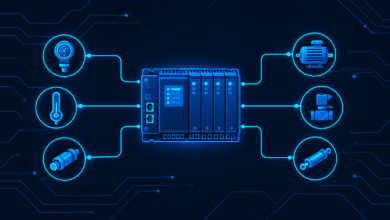
Industrial control, by contrast, often can’t tolerate that uncertainty. A safety interlock, a synchronized motion control system, or a real-time sensor feed needs data to arrive within a precise, guaranteed time window — not usually, but every time. This is exactly the kind of determinism we cover in our PLC and industrial automation guide. Engineers traditionally delivered it through specialized industrial Ethernet variants or dedicated fieldbus networks rather than standard Ethernet.
What Is TSN?
TSN is a set of IEEE 802.1 standards that add deterministic, time-sensitive capabilities to standard Ethernet. Rather than inventing an entirely new networking technology, TSN extends Ethernet itself. This means TSN-capable devices can, in principle, share the same physical network infrastructure as standard IT traffic. TSN’s mechanisms ensure time-critical data still gets the guaranteed, precise delivery it needs alongside everything else running on that network.
Core TSN Mechanisms
Time Synchronization
TSN relies on precise clock synchronization across all devices on the network, typically using IEEE 802.1AS, a profile of the Precision Time Protocol. Every device needs a shared, accurate sense of time. Without it, the other TSN mechanisms — which depend on precise scheduling — simply can’t work.
Scheduled Traffic
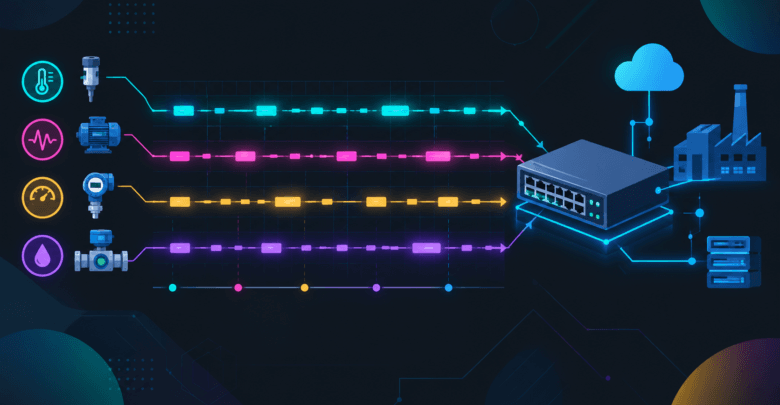
TSN allows engineers to schedule network traffic with microsecond precision, reserving specific time slots for time-critical data. This way, that data always gets through exactly when expected, regardless of what other traffic happens to be on the network at that moment.
Frame Preemption
Standard Ethernet sends one frame at a time, and a large, lower-priority frame already in transit can delay a smaller, urgent frame behind it. TSN’s frame preemption mechanism lets a high-priority frame interrupt a lower-priority frame already in transmission, reducing worst-case latency for time-critical traffic.
Stream Reservation
TSN includes mechanisms for reserving guaranteed bandwidth and latency characteristics for specific data streams across the network. This ensures critical traffic gets dedicated resources, rather than competing for bandwidth with best-effort traffic on a first-come, first-served basis.
TSN vs Traditional Industrial Ethernet
Industrial facilities have relied on proprietary industrial Ethernet variants — EtherNet/IP, PROFINET, EtherCAT, and others — for years. Each adds its own modifications to standard Ethernet to achieve deterministic timing. These protocols work well, but they typically require dedicated, vendor-specific hardware and don’t easily interoperate with each other or with standard IT networking equipment.
TSN takes a different approach. Rather than offering a complete proprietary protocol, it provides a standardized set of extensions built on Ethernet itself. This means TSN-based systems have the potential to interoperate more freely across vendors and to share network infrastructure with standard IT traffic, rather than requiring a separate, dedicated industrial network running in parallel.
Why TSN Matters for Industrial IoT
Converged Networks
TSN makes it practical to run time-critical control traffic and standard IT/IIoT data traffic — analytics, cloud connectivity, video streams — on the same physical network, rather than maintaining separate dedicated networks for each. This directly supports the kind of OT/IT convergence that IIoT initiatives increasingly require, simplifying network architecture considerably compared to running parallel infrastructure.
Vendor Interoperability
Because TSN is a standardized extension of Ethernet rather than a proprietary protocol, it offers a path toward better interoperability between equipment from different manufacturers. This addresses a long-standing pain point in industrial automation, where vendor lock-in around proprietary industrial Ethernet variants has historically limited flexibility.
Supporting Advanced Applications
Emerging applications like synchronized multi-robot coordination, high-precision motion control, and real-time machine vision benefit directly from TSN’s deterministic guarantees, enabling coordination and precision that best-effort networking simply can’t support reliably.
Foundation for 5G and Wireless TSN
Engineers increasingly extend TSN concepts into wireless domains, including integration with private 5G networks. The goal: bring similar deterministic guarantees to wireless industrial connections, not just wired Ethernet.
Practical Considerations for TSN Adoption
Hardware Requirements
TSN requires network switches, network interface cards, and end devices that specifically support TSN’s standards. This means adoption often requires new or upgraded hardware rather than simply reconfiguring existing standard Ethernet equipment.
Configuration Complexity
Setting up TSN’s scheduling and reservation mechanisms correctly requires careful network planning and configuration. This is a more involved process than deploying standard Ethernet, though tooling to simplify it continues to mature as adoption grows.
Coexistence with Existing Industrial Ethernet
Many facilities already have significant investment in existing industrial Ethernet variants like PROFINET or EtherCAT. Where it makes sense, the transition to TSN often happens gradually, with TSN capabilities layered in alongside existing infrastructure rather than requiring a disruptive, all-at-once network replacement.
Standards Still Maturing
Core TSN standards are well established. However, the broader ecosystem — including how different industrial protocols map onto TSN, and interoperability testing across vendors — continues to mature, meaning some practical implementation details are still settling as adoption grows.
Conclusion
TSN represents a meaningful shift in industrial networking philosophy. Rather than relying entirely on proprietary, dedicated industrial networks to achieve deterministic performance, it brings that same reliability to standard Ethernet infrastructure, infrastructure that can be shared with broader IT and IIoT traffic. As industrial facilities continue pursuing the kind of converged, connected architecture that modern IIoT demands, TSN is becoming a foundational piece of the networking layer making that convergence practical rather than just theoretical.
For more on the broader industrial communication landscape TSN fits within, our guide on Industrial Automation and PLC covers the protocols and systems TSN increasingly needs to support.