

Introduction to Modern ADAS Connectivity Solutions
Autonomous driving technologies are evolving rapidly from basic driver assistance to full vehicle autonomy. As a result, ADAS connectivity solutions have become the ultimate backbone of modern automotive engineering. Advanced Driver Assistance Systems (ADAS) rely on an intricate network of cameras, radar, LiDAR, and ultrasonic sensors to make split-second driving decisions.
However, processing this massive influx of real-time data requires ultra-fast and reliable network architectures. Therefore, automotive engineers must design robust connectivity frameworks to handle high-bandwidth data with near-zero latency. In this article, we explore the core protocols, hardware interfaces, and communication paradigms that power next-generation ADAS connectivity.
Key Hardware Protocols in ADAS Architecture
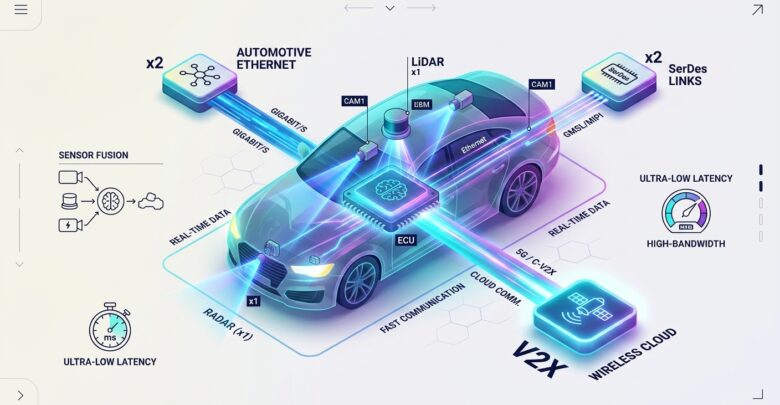
A modern ADAS connectivity solution must bridge the gap between high-bandwidth sensors and central Electronic Control Units (ECUs). Traditional CAN networks are no longer sufficient for raw video streams and high-resolution point clouds. Therefore, engineers deploy advanced high-speed hardware protocols across the vehicle.
+-----------------------------------------------------------------------+
|                         ADAS SENSOR FUSION ENGINE                     |
+-----------------------------------------------------------------------+
        ^                              ^                          ^
        | SerDes                       | Auto Ethernet            | CAN-FD
+---------------+              +---------------+          +---------------+
|  HD Cameras   |              | LiDAR / Radar |          | Vehicle Sensors|
+---------------+              +---------------+          +---------------+
1. High-Speed SerDes (Serializer/Deserializer)
Uncompressed video feeds from 4K cameras demand gigabit-per-second transmission rates. Consequently, SerDes technologies—such as FPD-Link, GMSL, and MIPI A-PHY—enable raw visual data transfer. These protocols transmit uncompressed camera data over lightweight coaxial cables with minimal latency.
2. Automotive Ethernet (100BASE-T1 / 1000BASE-T1)
Automotive Ethernet serves as the standard backbone for high-bandwidth vehicle networking. Unlike consumer Ethernet, Automotive Ethernet operates over a single unshielded twisted pair. As a result, it significantly reduces harness weight while delivering data speeds up to 10 Gbps.
3. CAN-FD and LIN Networks
High-bandwidth protocols handle heavy perception data. Meanwhile, CAN-FD and LIN networks handle low-cost control signals. They reliably transmit critical safety commands to steering actuators, brake modules, and chassis control systems.
Sensor Fusion & Edge Computing in Autonomous Vehicles
Sensor data aggregation forms a critical layer in every ADAS connectivity solution. Sensor fusion effectively combines inputs from heterogeneous sensors, such as cameras, radar, and LiDAR. Consequently, the central unit creates a accurate, unified model of the vehicle’s surroundings.
[ Camera Data ] ---\
[ Radar Data  ] ----+---> ( Edge AI Processing Unit ) ---> Real-Time Control
[ LiDAR Data  ] ---/
Engineers deploy Edge Computing nodes directly within the vehicle’s ECU architecture. Therefore, the system processes raw sensor data locally instead of offloading it to external clouds. This edge-first approach reduces processing latency to under 5 milliseconds. Ultimately, this ultra-low latency enables instant emergency braking and effective collision avoidance.
V2X (Vehicle-to-Everything) & Cellular IoT Integration
External connectivity is essential for modern Cooperative ADAS (C-ADAS). Vehicle-to-Everything (V2X) communication allows vehicles to interact seamlessly with external road infrastructure and nearby entities:
- V2I (Vehicle-to-Infrastructure): Communicating directly with smart traffic lights and electronic road signs.
- V2V (Vehicle-to-Vehicle): Sharing speed, location, and braking intent with surrounding cars.
- V2P (Vehicle-to-Pedestrian): Detecting vulnerable road users via smartphone cellular signals.
                  +-----------------------+
                  |    V2X Cloud / Edge   |
                  +-----------------------+
                              ^
                              | 5G / C-V2X
                              v
    +---------------------------------------------------+
    |                   HOST VEHICLE                    |
    |  +---------+      +----------------+     +-----+  |
    |  | Camera  | ---> | ADAS Controller| <---| V2V |  |
    |  +---------+      +----------------+     +-----+  |
    +---------------------------------------------------+
C-V2X vs. Dedicated Short-Range Communications (DSRC)
DSRC relies primarily on traditional Wi-Fi protocols. In contrast, Cellular V2X (C-V2X) leverages modern 5G NR networks. Furthermore, C-V2X provides longer communication range and higher reliability. Therefore, major automotive manufacturers prefer C-V2X for future vehicle designs.
Cybersecurity Challenges in ADAS Connectivity
Connecting an ADAS controller to external networks introduces potential security risks. Therefore, engineers must implement multi-layered defenses according to ISO/SAE 21434 standards:
- Hardware Security Modules (HSMs): Storing cryptographic keys securely to enable verified boot sequences inside ECUs.
- Encrypted In-Vehicle Networks: Applying MACsec protocol over Automotive Ethernet connections to prevent data tampering.
- Over-The-Air (OTA) Security: Verifying software update signatures thoroughly before execution.
Conclusion: The Future of ADAS Connectivity Solutions
The path toward fully autonomous driving relies heavily on reliable ADAS connectivity solutions. By integrating SerDes links, Automotive Ethernet backbones, Edge AI fusion, and 5G C-V2X systems, engineers can build safe, resilient automotive architectures.
Selecting the right connectivity stack represents the most important step toward next-generation mobility.
For more hardware tutorials and modern embedded technology trends, explore our complete [IoT Magazine] collection.