

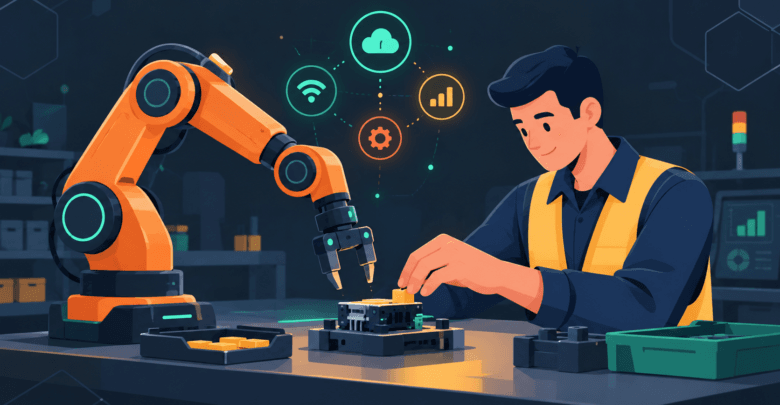
Traditional industrial robots work behind safety cages. They’re fast, strong, and powerful, but they can’t share space with people. Collaborative robots, or cobots, change that. They work right beside human operators, without the heavy fencing. Meanwhile, IIoT connects them to the rest of the factory, turning each cobot into a source of useful data.
This guide covers what cobots are, how they differ from traditional robots, and where IIoT adds real value. We’ll also look at the practical challenges of deploying them.
What Is a Cobot?
A cobot is a robot designed to work safely alongside people in a shared workspace. Engineers build in features that limit force and speed. As a result, a cobot can stop or slow down the moment it touches something unexpected. This makes close human-robot collaboration practical.
Cobots usually handle repetitive or physically tiring tasks. Humans, in turn, focus on work that needs judgment and dexterity. The two complement each other rather than compete.
Cobots vs Traditional Industrial Robots
| Factor | Traditional Industrial Robot | Cobot |
|---|---|---|
| Workspace | Fenced-off cell | Shared with humans |
| Speed and payload | Very high | Moderate |
| Programming | Specialist skills often required | Often simple, guided teaching |
| Deployment time | Weeks to months | Days to weeks |
| Flexibility | Fixed, high-volume tasks | Easy to redeploy |
| Typical cost | Higher total installed cost | Lower entry cost |
Traditional robots still win on raw speed and payload. Cobots, however, win on flexibility and ease of deployment. Many factories end up using both.
How Cobots Stay Safe Around People
Force and Power Limiting
Cobots monitor the force they apply. If contact exceeds a safe threshold, they stop immediately. This keeps accidental contact from causing injury.
Speed and Separation Monitoring
Sensors track how close a person is. The cobot slows down as someone approaches. It stops completely if the person gets too near.
Hand Guiding
Operators can physically guide a cobot arm through a motion. The robot records that path. Consequently, teaching a new task often takes minutes rather than days of programming.
Safety Standards
Industry standards define how engineers should assess and validate collaborative applications. Importantly, a safe robot doesn’t guarantee a safe application. The tool on the arm, the workpiece, and the layout all matter.
Where IIoT Adds Value to Cobots
A standalone cobot already does useful work. Connecting it through IIoT, however, unlocks much more.
Performance Monitoring
A connected cobot reports cycle times, error rates, and uptime. Managers can then spot slow stations and fix them. Over time, this data reveals patterns no one would notice by watching alone.
Predictive Maintenance
Joint temperatures, motor current, and vibration all signal wear. Analytics can flag a failing joint before it stops production. This mirrors the approach we describe in our IoT aircraft maintenance guide.
Integration with Control Systems
Cobots rarely work alone. They usually exchange signals with PLCs and SCADA systems that coordinate the wider line. Standard industrial protocols make this exchange possible.
Edge Processing
Vision-guided cobots generate large amounts of image data. Processing it locally keeps response times short. Our edge computing guide explains why this approach works so well here.
Digital Twin Simulation
Teams can model a cobot workcell in software before building it. They test layouts, cycle times, and safety zones virtually. Our digital twin guide covers this idea in more depth.
Common Cobot Applications
Machine Tending
Cobots load and unload parts from machines. This frees operators from monotonous, repetitive work.
Assembly and Screwdriving
Cobots handle repeatable fastening tasks with consistent torque. Humans can then focus on the trickier assembly steps.
Quality Inspection
Paired with cameras, cobots inspect parts from multiple angles. They log every result, which supports traceability.
Packaging and Palletizing
Cobots stack boxes and fill cartons reliably. Smaller manufacturers especially value how quickly they can redeploy the same arm to a new product.
Lab and Light Assembly Work
Cobots also appear in labs and small-batch production. There, flexibility matters more than raw throughput.
Challenges of Deploying Cobots
Application Design Matters More Than the Robot
A cobot’s tool, the part it handles, and the surrounding layout all affect safety. Therefore, teams need a proper risk assessment for each application, not just a safe robot.
Speed Trade-Offs
Safety limits keep cobots slower than traditional robots. For high-speed, high-volume work, a caged robot may still be the better fit.
Integration Effort
Connecting a cobot to existing systems still takes engineering time. Mismatched protocols and data formats can slow projects down. This echoes the broader OT vs IT integration challenges across industrial IoT.
Cybersecurity
A connected cobot is also a networked device. Consequently, it needs the same careful segmentation and access control as any other piece of industrial equipment.
Workforce Acceptance
People sometimes worry that cobots threaten their jobs. Clear communication and training make a real difference. In practice, many teams find cobots take over the tiring tasks while people move to more skilled roles.
Getting Started with Cobots
- Pick a simple first task. Choose something repetitive, stable, and low-risk.
- Run a risk assessment. Evaluate the full application, not just the robot.
- Plan the data connection early. Decide what you want to measure before installation.
- Start small, then scale. Prove value on one station before expanding.
Conclusion
Cobots bring automation to places traditional robots can’t reach. They sit beside people, redeploy quickly, and need far less specialist programming. Pair them with IIoT, and they become more than machines. They become connected data sources that support predictive maintenance, performance tracking, and continuous improvement. As costs fall and tooling matures, expect cobots to keep spreading across factories of every size.
For more on the control layer cobots connect to, see our guide on Industrial Automation and PLC.