


Walk into a manufacturing company’s IT department and ask about MES and ERP. You’ll often get an answer that makes them sound interchangeable. Both manage data, both involve software, and both sit somewhere above the shop floor. In practice, they solve very different problems. Understanding where each one fits matters for anyone connecting industrial IoT data into a company’s broader business systems.
This guide breaks down what MES and ERP actually do, how they differ, and where they both fit alongside the PLCs and SCADA systems running the physical production floor.
What Is MES (Manufacturing Execution System)?
A Manufacturing Execution System manages and monitors work-in-progress on the production floor in real time. It tracks what’s being produced right now, which work orders are active, and quality data as products move through production. It also captures detailed traceability — which materials, operators, and process parameters went into a specific unit of output. MES operates at the timescale of the shop floor: minutes and hours, not the days and weeks typical of higher-level business planning.
What Is ERP (Enterprise Resource Planning)?
An ERP system manages an organization’s broader business processes. These include finance, procurement, inventory planning, human resources, sales order management, and overall business reporting. ERP operates at a company-wide, strategic timescale. It plans production weeks or months in advance, manages supplier relationships, and consolidates financial data across an entire organization.
The Core Difference: Timescale and Scope
MES: Real-Time Shop Floor Execution
MES answers questions like: What’s running on this line right now? Has this batch passed quality checks? Which operator and which machine produced this specific unit? It operates in near-real-time, directly connected to the production environment, often pulling data from PLCs and SCADA systems to maintain an accurate, current picture of the floor.
ERP: Strategic Business Planning
ERP answers questions like: What should we produce next month based on sales forecasts and current inventory? It operates on a planning and reporting timescale, working with summarized data rather than granular, real-time detail.
How MES and ERP Work Together
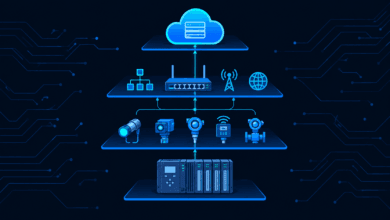
Rather than competing systems, MES and ERP form complementary layers in a well-integrated manufacturing operation. ERP sends production plans and work orders down to MES, telling the shop floor what needs to get made and by when. MES then executes that plan in real time, tracking production progress, quality results, and material consumption. This execution data flows back up to ERP, updating inventory levels and informing business reporting with actual production figures rather than planned estimates.
Engineers often describe this bidirectional flow using the ISA-95 standard — a widely referenced framework for structuring the relationship between business systems (ERP), manufacturing operations systems (MES), and the control systems (PLCs, SCADA) running the physical process.
Where IIoT Fits Between MES and ERP
Richer, Real-Time Data Feeding MES
IIoT sensors and connected equipment can feed MES with more granular, real-time data than traditional data collection methods. This reduces the manual data entry that historically introduced delays and errors into shop-floor tracking.
Analytics Bridging MES and ERP
IIoT platforms increasingly sit alongside MES and ERP, pulling data from both layers to generate analytics neither system was originally designed to provide on its own — cross-referencing real-time production data against business-level cost and planning data.
Predictive Capabilities
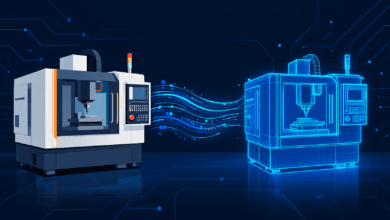
The predictive maintenance and digital twin concepts covered elsewhere in this series typically integrate at the MES level, since they need the real-time operational data MES handles. A predicted equipment failure, for example, might trigger both an MES-level maintenance work order and an ERP-level adjustment to production scheduling.
Common Implementation Challenges
Integration Complexity
Connecting MES and ERP, along with the underlying PLC/SCADA layer, often means bridging systems from different vendors with different data models. This echoes the broader OT vs IT integration challenges common across industrial IoT projects.
Data Latency Mismatches
MES expects near-real-time data. ERP, on the other hand, typically works with periodic updates — hourly, daily, or even less frequent in some configurations. Designing the right data flow requires understanding which decisions actually need real-time data versus which can work with periodic summaries.
Organizational Ownership
Operations or manufacturing engineering teams often own MES, while IT or finance typically owns ERP. This split reflects the broader organizational divide that shows up throughout industrial IoT projects, requiring deliberate cross-functional collaboration.
Scope Creep
Organizations sometimes try to make MES handle ERP-level planning functions, or push ERP down into real-time shop-floor tracking it wasn’t designed for. Both approaches tend to create more problems than they solve. Respecting each system’s intended scope generally produces a more maintainable, reliable architecture.
When You Need Both (and When You Might Not)
Large, complex manufacturing operations with significant production volume, multiple product lines, or strict quality and traceability requirements typically benefit from a dedicated MES alongside ERP. Smaller operations with simpler production processes sometimes manage with ERP alone instead, supplemented by lighter-weight shop-floor tracking tools. The right choice depends heavily on production complexity and the actual business value of granular, real-time shop-floor visibility.
Conclusion
MES and ERP solve genuinely different problems at genuinely different timescales. Understanding that distinction, rather than treating them as redundant or interchangeable, is essential for designing manufacturing IT architecture that actually works. As IIoT continues generating richer real-time data from the shop floor, the connection between these two layers becomes increasingly valuable — turning what was once a once-a-day data sync into a much tighter feedback loop between what’s planned and what’s actually happening in production.
For more on the control systems MES typically connects to on the shop floor, our guide on Industrial Automation and PLC covers the layer directly beneath MES in a typical manufacturing IT architecture.