Walk into almost any factory, water treatment plant, or power station, and you’ll find the same quiet workhorse running the show: the PLC, or Programmable Logic Controller. It rarely gets the attention that flashier IoT platforms or AI systems get. Even so, it’s the component that actually keeps physical industrial processes running safely and reliably, day after day. Understanding PLCs — and the broader ecosystem of systems they connect to — is essential groundwork for anyone working in or writing about industrial IoT.
This guide introduces the core building blocks of industrial automation, how they fit together, and where IoT and IIoT (Industrial IoT) are extending this traditional ecosystem.
What Is a PLC?
A Programmable Logic Controller is a ruggedized industrial computer designed to control machinery and processes in real time. Unlike a general-purpose computer, a PLC is built for a harsh factory floor environment. It has to withstand vibration, temperature extremes, and electrical noise, all while delivering extremely reliable, deterministic operation. When a PLC controls a conveyor belt or a safety interlock, it needs to respond within a predictable, guaranteed time window, every single time.
How a PLC Works
A PLC continuously runs a cycle called a “scan.” First, it reads input signals from sensors, switches, or other devices. Then, it executes its programmed logic against those inputs. Finally, it updates its outputs to motors, valves, lights, or alarms accordingly. This scan cycle repeats continuously, often many times per second, giving the PLC its real-time responsiveness.
Ladder Logic and PLC Programming
Engineers most commonly program PLCs using ladder logic, a visual language that resembles electrical relay wiring diagrams. This design choice traces back to PLCs’ history as replacements for banks of physical relays. Other standardized languages exist under the IEC 61131-3 standard. These include function block diagrams, structured text, and sequential function charts, giving engineers flexibility depending on the complexity of the logic involved.
The Broader Industrial Automation Ecosystem
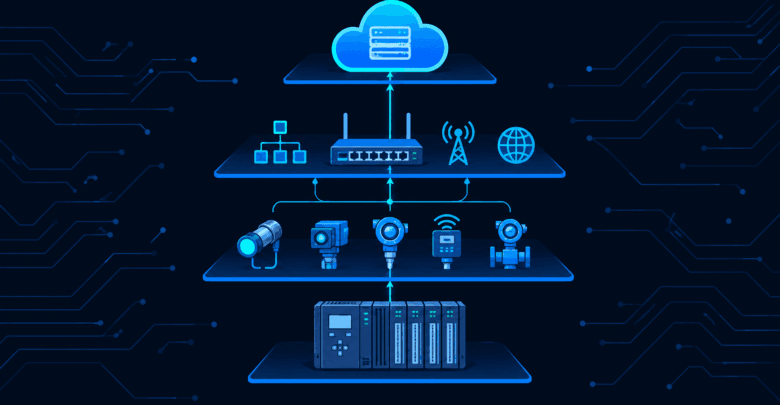
A PLC rarely operates in isolation. Instead, it sits within a layered ecosystem of systems, each handling a different scope of the overall operation.
Sensors and Actuators (The Field Level)
At the foundation, sensors capture physical conditions such as temperature, pressure, flow, position, and proximity. Meanwhile, actuators — motors, valves, pumps — carry out physical actions. These devices connect directly to the PLC’s inputs and outputs, forming the bridge between the physical process and the digital control system.
HMI (Human-Machine Interface)
An HMI is the screen or panel operators use to monitor and interact with a process. Through it, they view real-time values, adjust setpoints, and acknowledge alarms. HMIs range from small touchscreen panels mounted directly on equipment to full desktop applications in a control room.
SCADA (Supervisory Control and Data Acquisition)
SCADA systems sit a level above individual PLCs. They aggregate data and control across multiple PLCs, often spread across a large facility or even multiple geographically separate sites. In turn, SCADA provides centralized monitoring, historical data logging, alarming, and often a broader HMI layer for supervisory-level oversight.
DCS (Distributed Control System)
A DCS is conceptually similar to SCADA. However, engineers typically use it in continuous process industries, like chemical plants or refineries, where control logic gets distributed across many controllers working together as a tightly integrated system. Over time, the line between DCS and SCADA has blurred somewhat, since both categories have absorbed features from each other.
MES (Manufacturing Execution System)
Sitting above the real-time control layer, an MES manages the broader production process. It tracks work orders, quality data, production scheduling, and traceability. In doing so, it bridges the gap between shop-floor control systems and higher-level business systems like ERP (Enterprise Resource Planning).
Industrial Communication Protocols
Getting all these layers talking to each other requires standardized communication protocols. Over the decades, the industrial world has accumulated quite a few.
Fieldbus Protocols
Engineers designed protocols like Modbus, Profibus, and DeviceNet specifically for reliable, real-time communication between field devices and PLCs. These often run over simple wired connections built to stay robust in electrically noisy industrial environments.
Industrial Ethernet
Newer protocols like EtherNet/IP, PROFINET, and EtherCAT bring standard Ethernet networking into the industrial space. However, they include modifications to guarantee the deterministic timing that industrial control requires — something standard consumer Ethernet doesn’t inherently provide.
OPC UA
OPC UA (Open Platform Communications Unified Architecture) has emerged as a leading standard for secure, vendor-neutral data exchange between industrial systems and higher-level IT systems, including cloud platforms and IIoT applications. Its growing adoption is a major reason why bridging traditional industrial automation with modern IoT platforms has become significantly more practical in recent years.
Where IIoT Extends This Traditional Ecosystem
Industrial IoT builds on top of this existing automation stack rather than replacing it. In doing so, it adds new capabilities the traditional layers weren’t originally designed for.
Cloud Connectivity and Remote Monitoring
IIoT platforms connect data from PLCs, SCADA, and sensors up to cloud-based systems. This enables remote monitoring and analysis from anywhere, rather than requiring someone to be physically on-site.
Advanced Analytics and Predictive Maintenance
Traditional SCADA and DCS systems excel at real-time control and alarming. However, they’re generally not designed for the kind of historical trend analysis and machine learning-driven predictive maintenance that IIoT platforms bring. The same predictive maintenance principles covered in our IoT aircraft maintenance guide apply broadly across industrial equipment of all kinds.
Digital Twins
IIoT data feeding into digital twin platforms (covered in more depth in our digital twin guide) lets engineers simulate and optimize industrial processes using real operational data. As a result, what was traditionally a control and monitoring function extends into a genuine simulation and optimization capability.
Edge Computing
Rather than sending all data to the cloud, edge computing devices process data locally, close to the PLCs and sensors generating it. This reduces latency for time-sensitive decisions and cuts the bandwidth needed to send everything to a central cloud platform.
Why This Distinction Matters: OT vs IT
A recurring theme in industrial automation is the historical separation between OT (Operational Technology) and IT (Information Technology). The PLCs, SCADA, and control systems fall under OT, keeping physical processes running. Conventional computing and networking infrastructure falls under IT. These two worlds developed with very different priorities: OT prioritizes uptime, safety, and deterministic timing above all else, while IT has traditionally prioritized data security, flexibility, and rapid iteration.
IIoT sits directly at the intersection of these two worlds. As a result, much of the practical challenge in industrial IoT deployments comes from bridging this gap — getting OT engineers and IT teams to collaborate effectively, and building systems that respect OT’s safety and reliability requirements while still delivering the data accessibility and analytics IT and business teams expect.
Common Challenges in Industrial Automation Environments
Legacy Equipment
Many industrial facilities run equipment and PLCs that are decades old, often without modern connectivity options built in. Consequently, retrofitting older equipment with IoT sensors and gateways to bridge it into a modern IIoT platform is a common and sometimes significant undertaking.
Cybersecurity
Industrial control systems were historically designed assuming a physically isolated network, with little emphasis on cybersecurity. As these systems increasingly connect to broader IT networks and the cloud for IIoT purposes, securing them against cyber threats has become a major and ongoing industry focus. This concern grows given the potentially serious physical consequences of a compromised control system.
Vendor Fragmentation
The industrial automation world includes many vendors, each with their own proprietary protocols, software ecosystems, and hardware standards. This fragmentation makes full interoperability an ongoing challenge, though standards like OPC UA are steadily improving the situation.
Skills Gap
Effective industrial IoT implementation requires people who understand both traditional OT systems and modern IT/cloud technologies. This combination of skills remains relatively scarce compared to specialists in either domain alone.
Conclusion
The industrial automation ecosystem — from field-level sensors and PLCs up through SCADA, DCS, and MES layers — represents decades of engineering focused on reliable, real-time control of physical processes. IIoT doesn’t replace this foundation. Instead, it extends it, adding cloud connectivity, advanced analytics, and digital twin capabilities on top of a control layer that still needs to prioritize safety and determinism above all else. Understanding this layered structure, and the OT/IT divide running through it, is essential context for anyone working on industrial IoT projects rather than approaching the space as though it were a greenfield IT environment.
For a deeper look at how these principles apply to specific predictive and simulation use cases, our guides on Digital Twin Technology and IoT in Aircraft Maintenance cover related concepts in more depth.