

Every factory has a hidden cost: unplanned downtime. A single failed motor can halt an entire line. Teams then scramble to find parts, call technicians, and explain the delay. Predictive maintenance aims to prevent that scramble. It uses sensor data to spot trouble early, so repairs happen on your schedule, not the machine’s.
This guide explains how predictive maintenance works in industry, what you need to get started, and where projects often go wrong.
The Three Maintenance Strategies
Reactive Maintenance
Teams fix equipment after it breaks. This costs little upfront. However, failures strike at the worst times, and repairs often cost far more than planned work.
Preventive Maintenance
Teams service equipment on a fixed schedule, based on time or usage. This reduces surprise failures. On the other hand, it often replaces healthy parts too early and still misses failures that occur between inspections.
Predictive Maintenance
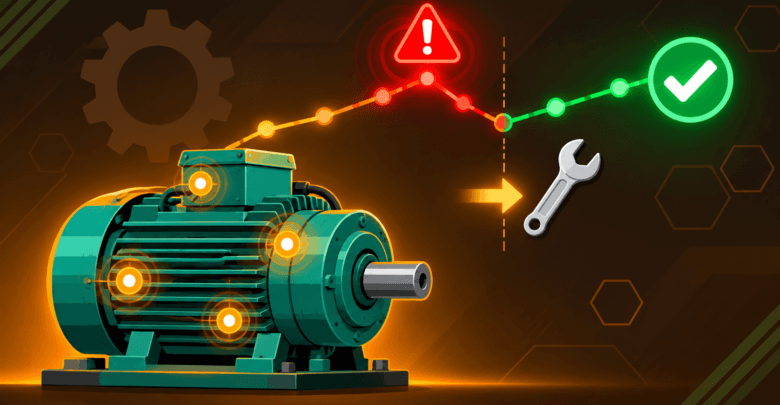
Teams monitor the actual condition of equipment and act when the data shows a problem developing. This approach targets the right machine at the right time. Consequently, it can cut both downtime and unnecessary work.
Most factories use a mix of all three. Predictive methods usually focus on critical, expensive, or failure-prone assets.
How Predictive Maintenance Works
Step 1: Measure
Sensors capture signals that change as equipment wears. Vibration, temperature, motor current, pressure, and acoustic noise are the most common. Our sensors and actuators guide covers these devices in detail.
Step 2: Collect and Connect
Data flows from sensors through PLCs, gateways, or wireless links into a central platform. Protocols like OPC UA help systems share it in a consistent format.
Step 3: Process
Some analysis happens close to the machine, using edge computing. This keeps response times short and reduces the data sent to the cloud. Longer-term analysis typically runs on a central platform.
Step 4: Analyze
Software looks for patterns that signal trouble. Simple methods compare readings against thresholds. More advanced methods use statistics or machine learning to detect subtle changes.
Step 5: Act
When the system flags a problem, it creates an alert or work order. Technicians then inspect the machine and plan the repair. Over time, their feedback improves the models.
Common Techniques
Threshold Alarms
The simplest approach triggers an alert when a value crosses a set limit. It’s easy to deploy. However, it can’t catch problems that develop gradually within normal ranges.
Trend Analysis
Tracking how a signal changes over weeks or months reveals slow degradation. A bearing’s vibration, for example, often creeps upward before failure.
Condition Indicators
Engineers extract specific features from raw signals, like frequency peaks in vibration data. These indicators link directly to known failure modes.
Anomaly Detection
Machine learning models learn what normal looks like. They then flag anything unusual. This helps when you lack labeled examples of failures.
Remaining Useful Life Estimation
Advanced models estimate how long a component can keep running. Planners can then schedule replacement before the predicted end of life.
Where Predictive Maintenance Pays Off
Rotating Equipment
Motors, pumps, fans, and compressors show clear vibration and temperature changes as they wear. They make ideal first candidates.
Critical Production Assets
Machines that stop an entire line when they fail justify the investment fastest.
Remote or Hard-to-Reach Equipment
Monitoring removes the need for frequent manual inspection in difficult locations.
Safety-Critical Systems
Early warning reduces the risk of dangerous failures.
The same principles apply across many industries. We explore a specific example in our IoT aircraft maintenance guide.
Connecting Maintenance to the Business
Predictive maintenance doesn’t live in isolation. Alerts should feed into the systems that plan and track work. Maintenance schedules, spare parts inventory, and production plans all interact. Therefore, many organizations connect their analytics to MES and ERP systems. A predicted failure can then trigger a work order and adjust the production schedule automatically.
Digital twins add another layer. They let teams simulate how equipment behaves and test maintenance decisions before applying them to the real machine.
Common Pitfalls
Starting Too Big
Projects that try to monitor everything at once often stall. Pick a small set of critical assets first.
Poor Data Quality
Faulty sensors, missing data, and inconsistent timestamps undermine every model. Fix the basics before adding advanced analytics.
No Failure Examples
Machine learning needs examples to learn from. Many assets fail rarely, so teams may need to rely on anomaly detection or engineering knowledge at first.
Ignoring the People
Technicians must trust the alerts. Therefore, involve them early, explain how the system works, and act on their feedback. A system that cries wolf quickly gets ignored.
Weak Security
Connected sensors and gateways expand the attack surface. This echoes the broader OT vs IT security challenges across industrial environments.
Unclear Business Case
Define the expected savings upfront. Measure downtime avoided, repair costs reduced, and parts saved. Without clear numbers, it’s hard to defend the project later.
A Simple Roadmap to Get Started
- Choose critical assets. Focus on machines where failure hurts most.
- Study failure history. Learn how and why these machines fail.
- Select the right sensors. Match them to the failure modes you want to detect.
- Collect a baseline. Gather data during normal operation.
- Start simple. Begin with thresholds and trends before moving to machine learning.
- Close the loop. Feed technician findings back into the system.
- Measure results. Track downtime, costs, and alert accuracy, then expand.
Conclusion
Predictive maintenance turns equipment data into foresight. It won’t remove every failure, and it takes careful setup. Still, when teams choose the right assets, collect clean data, and involve the people who maintain the machines, it delivers real, measurable value. Start small, prove the benefit, and grow from there.
For a closer look at the control systems that gather this data, see our guide on Industrial Automation and PLC.