

Industry 4.0 is one of those terms everyone uses and few define clearly. Some people picture robots. Others think of data dashboards or artificial intelligence. In reality, it describes something broader: the merging of physical production with digital technology. Machines, sensors, software, and people all connect and share information in real time.
This guide explains what Industry 4.0 means, which technologies power it, and how to approach it in practice. Along the way, it links to our deeper guides on each building block.
What Is Industry 4.0?
Industry 4.0 refers to the fourth major shift in manufacturing. The first used steam and water power. The second brought electricity and assembly lines. The third introduced computers and automation. The fourth connects all of these into smart, networked systems.
The core idea is simple. When machines can sense, communicate, and analyze, factories can adapt on their own. They spot problems sooner, change plans faster, and waste less.
The Core Pillars of Industry 4.0
Connected Devices and IIoT
Sensors and smart equipment collect data from every stage of production. This forms the foundation of everything else. Our sensors and actuators guide explains how these devices work.
Industrial Automation
Controllers run the machines and keep processes stable. PLCs handle fast local control. SCADA systems watch over larger operations from above.
Interoperability
Systems from different vendors must exchange data meaningfully. Standards such as OPC UA make this possible. Older protocols like Modbus still play a role in existing equipment.
Edge and Cloud Computing
Time-sensitive decisions happen close to the machine. Heavier analysis runs in the cloud. Our edge computing guide explains how the two work together.
Advanced Connectivity
Reliable networks tie everything together. Time-Sensitive Networking brings deterministic timing to Ethernet. Private 5G adds flexible wireless options.
Data Analytics and AI
Raw data only becomes useful once someone analyzes it. Analytics reveals patterns, predicts failures, and suggests improvements. Predictive maintenance is a leading example.
Digital Twins and Simulation
Virtual models mirror real equipment and processes. Teams test changes safely before touching the real thing. Our digital twin guide covers this in depth.
Robotics and Human-Machine Collaboration
Robots increasingly share space with people. Collaborative robots take over repetitive tasks, while humans focus on judgment and problem-solving.
Business System Integration
Shop-floor data must reach planning and management systems. Our guide on MES vs ERP shows how these layers fit together.
How the Pieces Fit Together
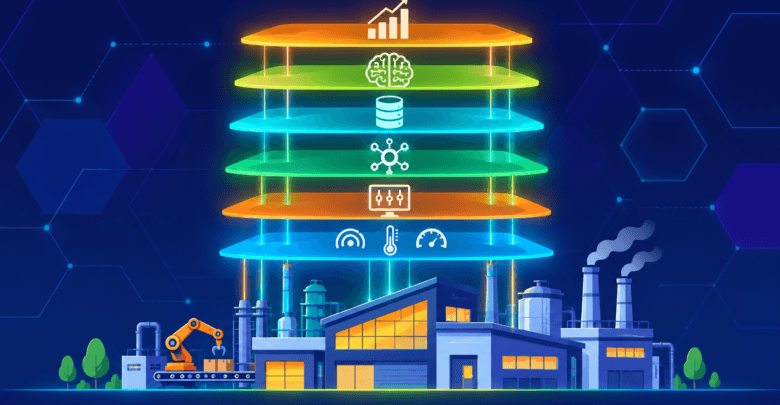
Think of Industry 4.0 as a layered stack.
- The physical layer. Machines, sensors, and actuators do the real work.
- The control layer. PLCs and SCADA keep processes running safely.
- The connectivity layer. Networks and protocols move data around.
- The data layer. Edge devices and cloud platforms store and process information.
- The intelligence layer. Analytics, AI, and digital twins turn data into decisions.
- The business layer. MES and ERP systems link production to planning.
Each layer depends on the ones below it. Consequently, weak foundations limit what the upper layers can achieve.
Benefits of Industry 4.0
Less Unplanned Downtime
Predictive methods catch problems before they stop production.
Better Quality
Continuous monitoring and automated inspection reduce defects.
Greater Flexibility
Connected, reconfigurable systems adapt faster to new products and changing demand.
Improved Efficiency
Real-time visibility exposes waste in energy, materials, and time.
Safer Workplaces
Automation takes over dangerous tasks, and monitoring detects hazards earlier.
Faster Decisions
Managers see current conditions rather than last week’s reports.
Challenges to Expect
Legacy Equipment
Many factories run machines that predate modern connectivity. Retrofitting them takes effort, and gateways often bridge the gap.
The OT and IT Divide
Operations and IT teams have different priorities and cultures. Bridging them takes deliberate collaboration. Our guide on OT vs IT explores this tension.
Cybersecurity
More connections mean more entry points for attackers. Security must grow alongside connectivity, not trail behind it.
Skills Gaps
Teams need people who understand both industrial systems and modern data technologies. Training and hiring both take time.
Unclear Return on Investment
Big transformation programs can drift without clear goals. Therefore, tie each project to a measurable outcome.
Data Overload
Collecting everything isn’t a strategy. Without purpose, data simply piles up.
How to Approach Industry 4.0 in Practice
- Start with a business problem. Focus on downtime, quality, or cost, not on technology for its own sake.
- Assess your current state. Map existing equipment, networks, and data sources.
- Pick a pilot. Choose one line or one asset where success is measurable.
- Build on standards. Open protocols reduce lock-in and ease future expansion.
- Secure from the start. Design network segmentation and access control early.
- Involve your people. Operators and technicians know where the real problems are.
- Scale what works. Expand gradually, based on proven results.
Common Myths
“It Means Replacing Everything”
Most successful programs build on existing equipment. They add sensors and connectivity rather than starting over.
“It’s Only for Large Factories”
Smaller manufacturers can benefit too. Affordable sensors and cloud tools lower the barrier considerably.
“It Removes People from Production”
In practice, it changes roles more than it removes them. Workers shift toward supervision, analysis, and improvement.
“More Technology Means Better Results”
The best projects start with a clear problem. Technology serves the goal, not the other way around.
Conclusion
Industry 4.0 isn’t a single product or a one-time project. It’s a gradual shift toward connected, data-driven production. Each building block, from sensors and PLCs to analytics and digital twins, adds capability. Together, they create factories that sense, learn, and adapt. Start small, build on solid foundations, and keep the focus on real business value.
To go deeper into any building block, follow the links above. A good place to begin is our guide on Industrial Automation and PLC.