

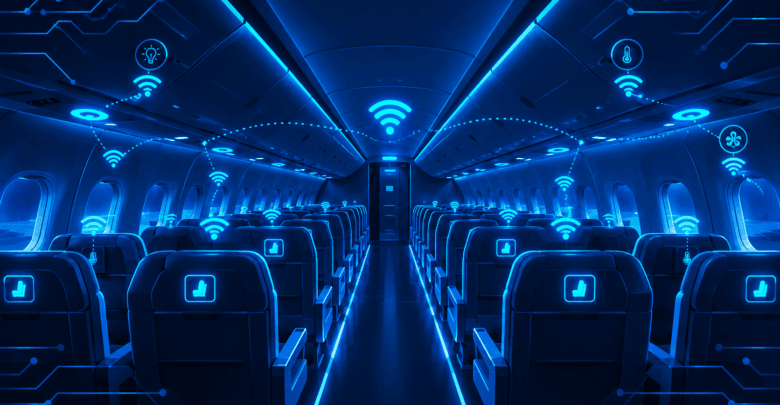
Step onto a modern commercial aircraft and you’re surrounded by connected technology. Seatback screens know your seat number. In-flight Wi-Fi follows the plane at 35,000 feet. Cabin systems quietly monitor everything from lighting to air quality. In short, IoT has moved into the cabin itself, not just the back-office systems that keep aircraft flying and on schedule.
This guide covers the main ways IoT technology is reshaping the passenger experience inside the cabin. We’ll also look at the technical challenges that come with connecting an aircraft cabin at altitude.
In-Flight Connectivity: The Foundation
Modern in-flight Wi-Fi relies on one of two main connectivity approaches. Each comes with different trade-offs.
Air-to-Ground (ATG) Systems
ATG systems connect the aircraft to a network of ground-based cell towers. This works similarly to how a phone connects to cellular towers — except the “phone” moves at hundreds of miles per hour, thousands of feet in the air. Airlines use ATG primarily for domestic and shorter routes. It works well over land with adequate tower coverage. However, it doesn’t function over oceans or remote areas without ground infrastructure.
Satellite Connectivity
For long-haul and international routes, aircraft connect via satellite links instead. Older systems use geostationary satellites. Newer ones use low-earth-orbit (LEO) satellite constellations, which offer significantly lower latency and higher bandwidth. As a result, the shift toward LEO satellite connectivity has been a major factor in why in-flight Wi-Fi speeds have improved noticeably in recent years.
IoT Applications Inside the Cabin
Seatback Entertainment and Personalization
Modern in-flight entertainment (IFE) systems increasingly connect to broader cabin networks. This allows personalization based on the passenger’s seat, ticket class, or pre-selected preferences submitted through an airline’s app before the flight. Some systems can push tailored content, meal reminders, or connecting flight information directly to a passenger’s screen or personal device.
Smart Lighting and Cabin Ambiance
IoT-controlled LED lighting systems can adjust color temperature and brightness throughout a flight. They dim for rest periods and brighten for meal service. Some systems even simulate sunrise and sunset patterns to help passengers adjust to new time zones.
Passenger Device Integration
Many airlines now let passengers use their own smartphones or tablets as a control interface. Passengers can adjust the entertainment system, control cabin lighting, or order food and drinks this way. This works by connecting personal devices to the aircraft’s cabin network via Bluetooth or a dedicated in-flight app.
Cabin Crew Tools
IoT-connected tablets give cabin crew access to real-time passenger information — special meal requests, connecting flight details, loyalty status. In addition, crew can communicate cabin conditions or maintenance issues directly to ground staff before landing.
Environmental Monitoring
Sensors throughout the cabin track temperature, humidity, and air quality in real time. This data feeds directly to the aircraft’s environmental control systems. Increasingly, it also feeds into predictive maintenance systems (covered in our aircraft maintenance guide), since gradual changes in cabin pressure or air handling performance can signal a system needing attention.
Baggage and Overhead Bin Tracking
Some newer cabin designs use sensors to detect overhead bin capacity in real time. This helps cabin crew direct passengers to bins with available space during boarding. It’s a small feature, but one that can meaningfully speed up boarding on a full flight.
The Passenger Experience Payoff
These systems add up to a cabin that feels more responsive and personalized than the one-size-fits-all experience of previous decades. Passengers get faster Wi-Fi, more relevant entertainment options, and more comfortable, consistent cabin conditions. Cabin crew, in turn, get better real-time information to handle requests and issues quickly. For airlines, this translates into brand loyalty. In fact, it often becomes a genuine competitive differentiator, particularly on long-haul routes where passengers have real choices between carriers.
Technical Challenges of Cabin IoT
Bandwidth Constraints at Altitude
Even with modern satellite systems, in-flight connectivity remains more constrained than typical ground-based broadband. Hundreds of passengers share a single aircraft’s connection. Therefore, bandwidth management and prioritization matter far more than on a home network.
Weight and Power Budgets
Every additional sensor, screen, or connected device adds weight to the aircraft. Aviation is famously sensitive to weight, given its direct impact on fuel consumption. As a result, cabin IoT systems need to justify their weight and power draw against the operational cost of carrying them on every flight.
Certification Requirements
Anything installed in an aircraft cabin — including IoT sensors and connected devices — must meet strict aviation safety certification standards before it can fly. This significantly slows the pace at which cabin technology can be updated. In comparison, a hotel or office building can simply install new IoT devices without a multi-year certification process.
Cybersecurity in a Connected Cabin
A cabin network handles passenger devices, entertainment systems, and crew tools all at once. This represents a meaningful attack surface. For this reason, aviation cybersecurity standards require careful isolation between passenger-facing systems and any network segment that touches flight-critical avionics.
Conclusion
The aircraft cabin has quietly become one of the more sophisticated IoT environments most people interact with regularly. Most passengers don’t think of seatback entertainment or in-flight Wi-Fi in those terms, yet that’s exactly what it is. From connectivity infrastructure to smart lighting to crew tools, IoT is steadily closing the gap between the in-flight experience and the connected, personalized environments passengers expect everywhere else in their lives. The constraints — weight, certification timelines, bandwidth at altitude — are real and specific to aviation. Even so, they haven’t stopped the trajectory: cabins keep getting smarter, flight after flight.
To see how similar sensor and connectivity principles apply elsewhere in aviation, our guides on IoT in Airport Operations and IoT in Aircraft Maintenance cover the terminal and maintenance sides of the same broader shift toward connected aviation.