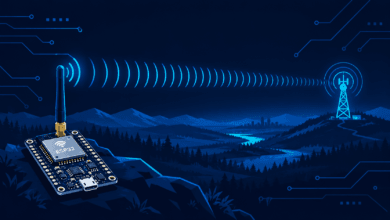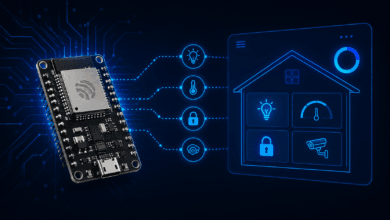


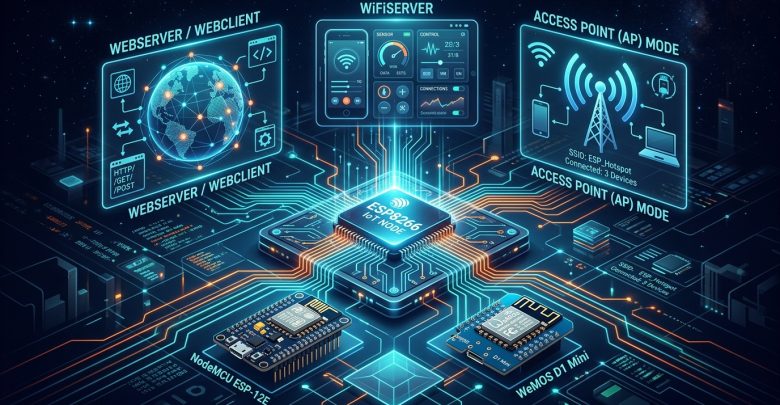
The ESP8266 module comes equipped with built-in Wi-Fi and features an internal high-frequency microcontroller that operates at dual clock frequencies of 80 MHz and 160 MHz. This chip offers exceptional flexibility for developers working on electronics and Internet of Things (IoT) projects.
Key Capabilities and Configuration Modes
- AT Command Communication: You can communicate with the module using an external microcontroller by sending AT commands.
- Direct Programming: It is possible to program the internal microcontroller directly, eliminating the need for AT commands entirely.
- WebServer Configuration: The module can be programmed as a WebServer to display client data on an internet WebPage and return appropriate responses to requests.
- WebClient & WiFiClient Support: It can be configured and utilized as both a WebClient and a WiFiClient.
- WiFiServer Configuration: You can configure it as a WiFiServer to wirelessly transmit sensor data to Wi-Fi-enabled devices (such as tablets, smartphones, and computers), where data can be stored or visualized through charts.
- Access Point (AP) Mode: The module can be configured to act as an independent wireless Access Point.
- Simultaneous Dual-Mode Operation: It can operate simultaneously in Access Point mode alongside any of the networking modes mentioned above.
Popular ESP8266 Board Models for Arduino
The ESP8266 chip is available in various pre-built breakout boards tailored for the Arduino ecosystem, including:
- NodeMCU v0.9 and NodeMCU v1.0
- WeMOS D1 and WeMOS D1 mini
All of these models feature an integrated USB port, making it seamless to connect them to the Arduino IDE for quick programming and code uploading.
#IoT #ESP8266 #NodeMCU #WeMOS #Arduino #WebServer #WirelessNetwork #EmbeddedSystems #SmartTech