

Sigfox is a global Low-Power Wide-Area Network (LPWAN) protocol. Specifically, it provides connectivity for low-power Internet of Things (IoT) applications.
By using Ultra-Narrow Band (UNB) radio technology, Sigfox connects remote devices efficiently. Consequently, endpoint nodes transmit small payloads over long distances with minimal power consumption.
Therefore, understanding Sigfox’s unique technical constraints helps system architects choose the right LPWAN standard.
What is Sigfox?
Sigfox operates as a lightweight cellular-like infrastructure designed specifically for M2M connectivity. Furthermore, it utilizes license-free Sub-GHz frequency bands globally.
As a result, devices achieve wide-area coverage without complex network subscriptions.
Key Technical Specifications of Sigfox
Sigfox trades high bandwidth for maximum energy efficiency and extreme range. In addition, its architecture relies on simple hardware designs.
The table below details the core operational and radio specifications of the Sigfox network:
| Technical Parameter | Specification / Limit |
|---|---|
| Radio Technology | Ultra-Narrow Band (UNB) DBPSK |
| Daily Message Quotas | Up to 140 uplink and 4 downlink messages daily |
| Uplink Payload Size | Up to 12 bytes per frame |
| Downlink Payload Size | Up to 8 bytes per frame |
| Data Transmission Rate | 100 bps (Europe) to 600 bps (USA) |
| Frequency Spectrum | License-free Sub-GHz ISM Bands |
| Line-of-Sight Range | 30–50 km (Rural) and 3–10 km (Urban) |
Architectural Advantages for IoT Deployments
Compared to traditional cellular standards like NB-IoT, Sigfox reduces operational complexity significantly.
- Ultra-Low Energy Consumption: Endpoint modules eliminate complex handshake protocols. Consequently, devices remain in deep sleep until an event triggers transmission. Therefore, battery lifespans can exceed 10 years easily.
- Low Silicon and Module Cost: Simpler radio front-ends reduce component count. As a result, total bill-of-materials costs remain very low.
- Hybrid Positioning Capabilities: Sigfox modules combine seamlessly with local protocols like BLE or Wi-Fi sniffing. Thus, developers implement multi-modal location tracking without draining batteries.
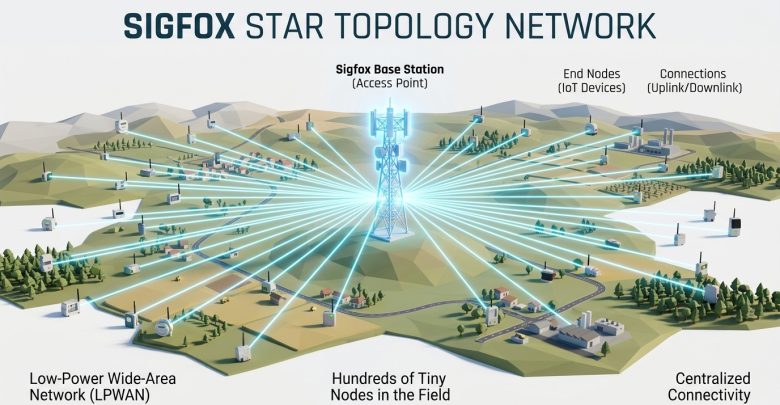
Network Architecture: Simplified Star Topology
Sigfox relies on a One-Hop Star Topology connecting endpoint nodes directly to base stations. However, it completely eliminates the need for complex local mesh routers.
- Endpoint Node: Transmits 12-byte UNB radio frames across multiple channels simultaneously. Consequently, spatial diversity ensures reliable signal reception.
- Sigfox Base Stations: Overlapping gateways receive incoming radio signals. Afterwards, they forward the demodulated packets over IP backhaul links.
- Sigfox Cloud Platform: Decodes and validates data payloads continuously. Ultimately, it pushes telemetry directly to application servers via RESTful Webhooks.
Primary Application Areas
Indeed, Sigfox provides ideal long-range connectivity for various commercial sectors:
- Smart Utilities and Metering: Automated remote reading for water, gas, and environmental sensors.
- Logistics and Asset Tracking: Long-range tracking of shipping pallets and supply chain containers.
- Agriculture and Smart Cities: Remote soil moisture sensing, weather telemetry, and smart waste management.
Conclusion
In conclusion, Sigfox offers an optimized connectivity framework for low-power IoT applications. Ultimately, low unit costs and multi-year battery life make Sigfox a top LPWAN choice.